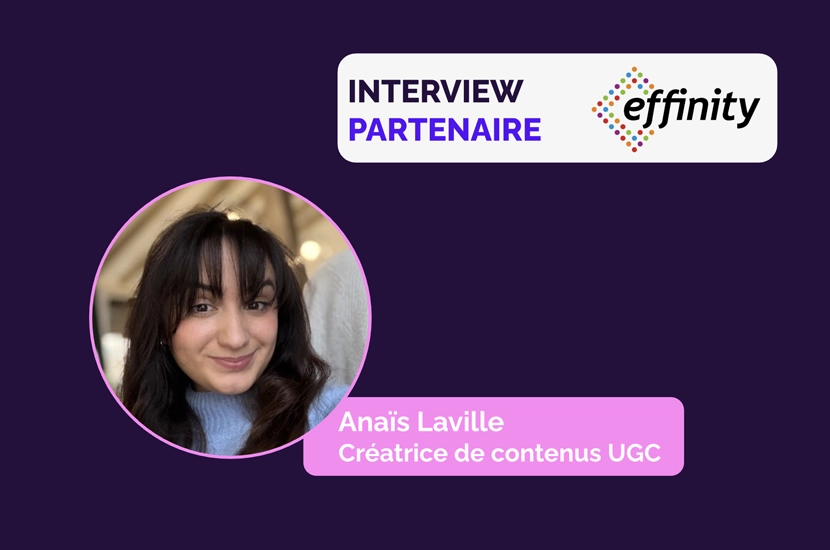
In an advertising ecosystem in constant search of credibility, UGC (User Generated Content) has established itself as more than just a trend: it has become the driving force behind conversion and reassurance. But to transform this authentic marketing lever into a genuine strategic asset, brands need to master its codes and requirements. With this in mind, Effinity, the preferred partner of advertisers for the management of high-performance UGC campaigns (profile sourcing, campaign structuring and ROI optimization), wanted to take you behind the scenes of the creative process.
We caught up with Anaïs Laville, a professional designer working with brands such as Lustucru and Coopérative U. From the technical rigor of the brief to the strict regulation of child labor, not forgetting the crucial distinction between influence and content creation, Anaïs gives us an expert insight to help brands navigate this world effectively.
Can you briefly introduce yourself and tell us about your background?
My name is Anaïs, I’m 32 and I’ve been a full-time UGC content creator for 2 years. I’ve worked with around a hundred brands: Lustucru, Tonies, Ebay, Yop, Deezer, Wecasa, Milan Jeunesse, Crédit Agricole, AD garage, Moulinex, etc. I have a 4-year-old boy with whom I sometimes create content for brands, via his modeling agency, but I think we’ll talk about that a little later. I don’t come from a marketing background, as I have a degree in Performing Arts, specializing in Theater. And I’ve worked in many different fields, including as a dresser for 6 years at Disneyland Paris.
How did you get into the world of UGC content?
A bit by chance. In early 2023, while scrolling through the networks, I come across ads that don’t look like “ads”. I don’t know it yet, but they’re UGC videos. I tell myself that brands using this type of format are pretty smart. I ask around, then get started, first by creating a portfolio of “fake UGC videos”. Then I contacted brands, agencies and so on. And the adventure begins!
What do you think distinguishes a UGC creator from an influencer?
These are 2 very different jobs. For me, the UGC creator has a fairly technical role. You can’t create a UGC video the same way you create influencer content. There are quite precise rules of structure. The UGC creator enables the brand to increase engagement, to have ads that convert, and also to create trust, consistency, presence and social proof. The influencer will create content that touches his or her community. The brand will seek out the audience of that community. The UGC creator is more accessible and authentic in the eyes of the viewer.
How do you choose which brands or projects to work with?
So, even though I’m not an influencer and my video content isn’t published directly in my name (apart from some whitelisted content), I make sure that the brand is aligned with my values. I don’t work with dropshipping-type products, for example, and I don’t work with content on cryptocurrencies or training courses that promise the sky’s the limit… It’s very important for me to choose the brands I work with carefully.
What can slow you down in a collaboration?
Requests for collaboration at 50 euros for 1 video of 1 minute, including scripting, shooting, editing, subtitles, and assignment of rights for 10 years (ha ha).
Can you tell us about a collaboration that particularly impressed you, and why?
I’ve been working on a long-term collaboration with Coopérative U for the past year. It’s a very interesting collaboration, because they trust me completely when it comes to proposing concepts, artistic direction and so on. I was able to meet them directly at head office. I think it’s really relevant, and it strengthens the relationship between designers and brands to be able to meet in real life the people we’re working with on a long-term basis. Even though we’re external service providers, I think the “human touch” is very important in our business.
How do you interact with agencies and brands: briefings, feedback, validation?
So, for example, with agencies like Effinity, the major advantage as a designer is that the agency acts as an intermediary. They manage and filter brand requests. Requests that can sometimes be complicated. It also saves time, as the agency will already create a complete brief (sometimes even a script). With agencies, there’s less risk of non-payment, and collaborations are more clearly defined: contracts, assignment of rights, etc. And if a collaboration goes well, we’re often re-solicited for other agency brands.
What advice would you give brands on how to work more effectively with UGC creators and maximize their ROI?
Choose your UGC creators carefully. Go for designers with natural acting, not too “commercial”. Good sourcing is essential, and I find that with agencies it’s a real advantage, because they know if a creator is performing well on another brand, for example. Then, my brands have to come up with a clear brief, accepting that you can’t say everything in just 1 video. They need to have precise angles for each video. They have to be prepared to A/B test hooks (which are really different from one another) and not hesitate to iterate scripts or concepts that work well with other designers.
Have you ever included your children in UGC content? If so, what’s the experience like for you and them?
My son and I have already collaborated with several brands, including Tonies (with whom we have agreed a 1-year exclusivity), Oxybul and Science & Vie Jeunesse for a YouTube ads campaign. These shoots are a little more technical for the parent, because you can’t make the child say whatever you want. The agency or brand has to bear in mind when briefing or writing the script that if the child refuses to shoot a particular scene, it has to be accepted. But personally, my son loves filming and it’s always a great time!
What advice would you give brands about working with designers who want to include their children in their videos?
If you want to work with children under the age of 16 in your advertising, it’s essential that their work is legally supervised. There is a strict law on this subject. The child must be registered with a modeling agency (or the parent must have DRIETTS approval) in order to manage his or her contract and payment to the deposit fund. If you don’t do things legally, both the agency and the parent risk a fine of between 6,000 and 75,000 euros. As well as 2 to 5 years’ imprisonment!
How do you see the evolution of AI in content creation? Do you see it as a help, a risk, or a complementary tool to your work as a creator?
I see it as a risk if brands suddenly decide to use only AI creators, but I find that at the moment it gives a bad image. The ads I see with AI avatars with 7 fingers per hand on social networks are often ads that get a bad buzz in the comments and discredit the brands. After that, if in 2 years’ time the avatars go unnoticed, I hope that a mention of “generated with AI” will be compulsory on all videos so as not to totally “mislead” viewers. AI sometimes helps me with the audio processing of my videos, or with adding elements in post-production, but I don’t want to use it to generate an avatar for myself and stop making my videos. AI can be a good tool, but you have to be careful to keep the content authentic.
What message would you like to pass on to brands hesitating to get into UGC?
Don’t hesitate! It’s a format you need to have in your media mix, just like static or studio ads. It’s a format that reassures, that builds confidence, and for me, the authenticity that UGC conveys remains the Number 1 value.