

Affiliate tracking refers to all the technologies used to accurately track a visitor’s path, from the click on a partner link to the final conversion (purchase, lead).
This mechanism, which is technically based on cookies, pixels or server-to-server exchanges (S2S), plays a dual role: it guarantees the reliable allocation of commissions to publishers, and provides the data needed to track marketing campaigns managed by Effinity.
Personalizing your affiliation means more than simply managing links; it also means knowing and understanding the precise role of the various affiliates that make up your network of partners. In a fragmented digital ecosystem, the tracking tool becomes the central engine of your acquisition strategy.
Here’s how multipoint tracking transforms raw data into a lever for sustainable growth.
Beyond the last click: the importance of multi-point tracking
The classic error in affiliate marketing is to pay and monitor only the last actor to generate a click. But to optimize your campaigns, you need a tracking tool that can identify several points of contact.
Definition and challenges of affiliate tracking
Multi-point tracking enables the conversion chain to be traced back far beyond shopping cart validation. By identifying several players (often up to five or more partners), the technology offers complete traceability. The aim is not just to know who has sold, but to visualize the paths taken by web users. This provides valuable information on the participation and involvement of affiliates upstream of the final converter.
The end of the linear view of the conversion tunnel
The customer journey is no longer linear. An Internet user may discover the brand via a blogger, compare via a coupon site, then finalize his purchase via a cashback site. Multi-point tracking enables us to move from a binary vision (sales/no sales) to a nuanced vision of the contribution of each lever.
How does affiliate tracking work?
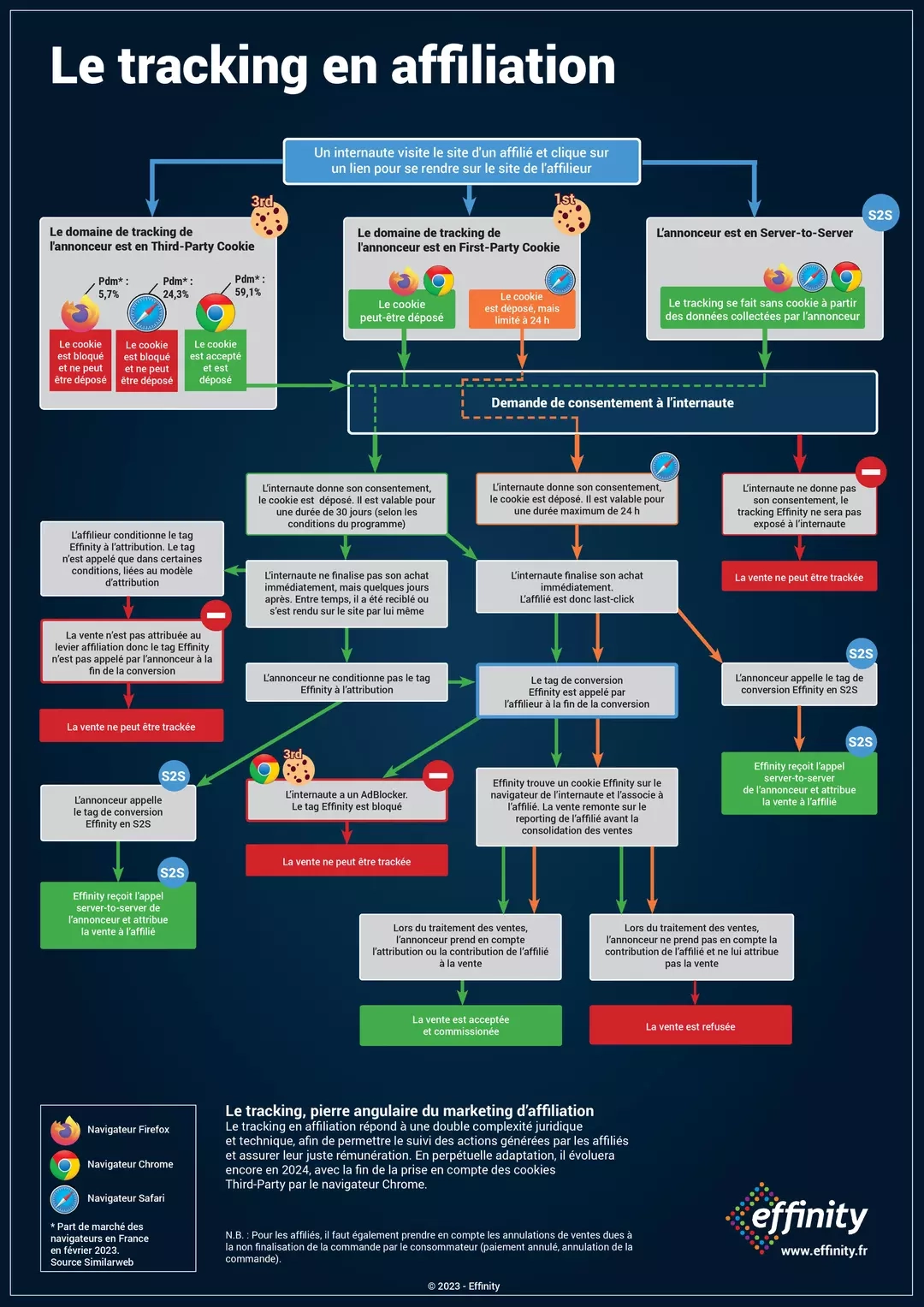
The affiliate tracking life cycle, from tag installation to server-to-server tracking, guaranteeing data reliability for the advertiser.
The 4 key stages of performance monitoring
- An Internet user visits an affiliate’s site and clicks on a tracked link to go to the advertiser’s site.
- Depending on the browser used by the surfer and whether the advertiser’s tracking domain is First-party Cookies, Third-Party Cookie or Server to server, the surfer’s consent request is facilitated.
- Depending on your browser and tracking technology, sales may or may not be tracked.
- Depending on the data collected, sales can be attributed to the affiliate site.
Tracking technologies used in affiliate marketing
- First-party cookies are deposited by the same domain as the site being visited, and are used to store a user’s preferences, log-in information, etc.
- Third-party cookies are deposited by a domain name other than that of the site visited, and are used to enable the sharing of information about an Internet user between different sites.
- Server-to-server tracking transmits tracking information from server to server. This system does not track the surfer, only his or her origin. There is therefore no deposit in the browser.
Mapping the customer journey for a global vision
Tracking isn’t just for commission accounting; it’s an essential marketing intelligence tool for understanding your program’s environment.
Visualize synergies between different levers
By collecting this data, you can draw up a true cartography of the program. This macroscopic view allows you to identify :
- Key players in the network.
- Their mode of operation and typology.
- Their precise moment of intervention in the conversion chain.
Identify the real value of business introducers
A detailed analysis of tracking data allows you to segment your affiliates according to their real role, not their assumed one:
- Initiators: those who generate cold traffic and brand awareness.
- Intermediaries: those who maintain interest and provide reassurance (comparators, reviews).
- Converters: those who trigger the final action (promo codes, cashback, retargeting). This detailed understanding of interactions is crucial to avoid “cannibalizing” your budget on affiliates who only intervene at the very end of a cycle that has already been acquired.
From “last click” dictatorship to intelligent attribution
The choice of attribution model doesn’t just determine who gets the commission; it dictates the survival of your partner ecosystem. If tracking collects the data, the attribution model determines its financial interpretation.
The limits of the standard model: the “last click
Historically, affiliation has been based on the last-click model. The entire commission is awarded to the last affiliate to generate a click before the sale. While simple, this model disproportionately favors converters over content creators. If bloggers and influencers aren’t paid for their evangelizing work, they stop promoting the brand, drying up the source of new traffic.
Alternative models for balancing the marketing mix
To correct this bias, modern platforms offer more sophisticated models:
- First click: 100% remuneration to the affiliate who introduced the brand. Ideal for brand awareness.
- The linear model: commission is divided equally between all points of contact.
- Time decay: the closer the click to purchase, the higher the commission.
The position-based model: strategic compromise
Often considered the most relevant model for generalist affiliation, this model strongly values two key players:
- Theintroduction (the first click) generally receives 40% of the commission.
- Conversion (the last click) receives 40%.
- Passers-by (intermediate clicks) share the remaining 20%. This model secures content providers (SEO, blogs) while motivating end converters.
Towards algorithmic and personalized attribution
The future lies in data-driven attribution. The algorithm analyzes your historical data to determine the real impact of each touchpoint. This makes it possible to create tailor-made management rules, such as prohibiting a coupon code site from receiving a commission if it comes just after a major influencer, or granting a bonus for the acquisition of new customers.
Transforming data into optimization strategy
The accumulation of data must serve a precise purpose: to optimize the long-term performance of the program.
Managing sales deduplication
Tracking makes it possible to fine-tune deduplication. This means ensuring that you don’t pay twice for the same sale (for example, an affiliate and a Google Ads campaign). It’s an essential lever for preserving sales margins and finding the best economic compromise.
Customize remuneration and supports
The information gathered on user behavior is used to adapt content:
- Capitalize on the best profiles by offering them preferential terms.
- Help small affiliates to grow by providing them with support adapted to the stages of the conversion tunnel they occupy.
- Adapt messages to help customers move from one stage to the next in the conversion tunnel.
The technical challenges of modern tracking
To remain effective, tracking must adapt to a rapidly changing technological context. Historical reliability based on third-party cookies is now being called into question.
Adapting to confidentiality constraints
With the RGPD in Europe and browser restrictions such as Apple’s ITP(Intelligent Tracking Prevention), browser-side tracking (client-side) is losing reliability. Depending on the sector, data loss can reach 10% to 30%.
Effinity: RGPD-compliant tracking
- anonymized tracking: no personal data exchanged without encryption.
- sha-256 encoding of personal information: e-mail address, telephone number, etc.
- maximum IT security standards.
- A DPO available to support customers.
The future of tracking: server-side and artificial intelligence
To guarantee reliable data and fair remuneration for affiliates, technology must evolve on two complementary fronts: infrastructure and analysis.
- Server-Side Tracking: this is becoming the norm for bypassing ad blockers and browser restrictions (ITP). Unlike the cookie deposited on the surfer’s computer, Server-Side tracking is carried out directly from server to server. This secures first-party data collection and ensures robust attribution.
- The contribution of Artificial Intelligence: where technical tracking reaches its limits (refusal of consent, complex cross-device navigation), AI takes over with conversion modeling. It enables :
-
- Filling data gaps: extrapolating untracked user behavior from known samples (probabilistic vs. deterministic).
- Detect fraud: algorithms identify suspicious or robotic click patterns in real time to clean up performance reports.
- Predict future value (LTV): estimate the long-term profitability of a customer brought in by an affiliate to adjust commission instantly.
-
To find out more about tracking, read our article Commanders Act, partnering advertisers in the age of cookieless.