

Server-side tracking (also known as server-to-server) involves moving data collection from the user’s browser to a secure server belonging to the company. Unlike traditional tracking (client-side), it bypasses browser restrictions, improves site speed and ensures better RGPD compliance. In 2026, it’s the benchmark solution for affiliate tracking to offset the loss of visibility caused by the end of third-party cookies and the rise of user control.
Effinity’s expertise at a glance
Faced with the complexity of server-side tracking, Effinity supports advertisers in securing their data and optimizing their ROI. Thanks to strategic partnerships and a robust infrastructure such as the Performance Center, Effinity guarantees reliable measurement and personalization of affiliate campaigns in a cookieless environment.
Why traditional tracking will be obsolete in 2026
Digital marketing is undergoing a profound transformation. Performance measurement, once simple, now faces a triple barrier: technical, legislative and behavioral.
The decline of third-party cookies and Google’s new paradigm
For years, the industry feared the “cookie apocalypse”. In 2024, Google pivoted to a user-choice approach within Chrome. However, this change did not save traditional tracking: a massive proportion of users now refuse to accept trackers. Server-side tracking is therefore emerging not as a workaround, but as a reliable first-party data infrastructure, capable of operating independently of the decisions of the web giants.
The limits of client-side in the face of ITP and ad blockers
Client-side tracking (via the browser) is under constant assault:
- ITP (Apple Safari): first-party cookies have a lifetime limited to 24 hours or 7 days, breaking the vision of a long customer journey.
- Ad-blockers: around 30% to 40% of tracking scripts are blocked before they are even loaded, creating “black holes” in your conversion reports.
- Core Web Vitals: the multiplication of JavaScript tags weighs down pages, degrading the user experience and SEO score.
For advertisers, the stakes are high: without a modern infrastructure, the loss of visibility on conversions can be as high as 40%. This is where Effinity comes in, transforming this technical constraint into a strategic opportunity, by relying on proprietary proprietary affiliate trackingthe keystone of attribution and performance.
What is server-side tracking: definition and operation
Server-side tracking isn’t just a technical evolution, it’s a paradigm shift. The principle is to centralize data collection on an intermediate server (backend) totally controlled by the advertiser.
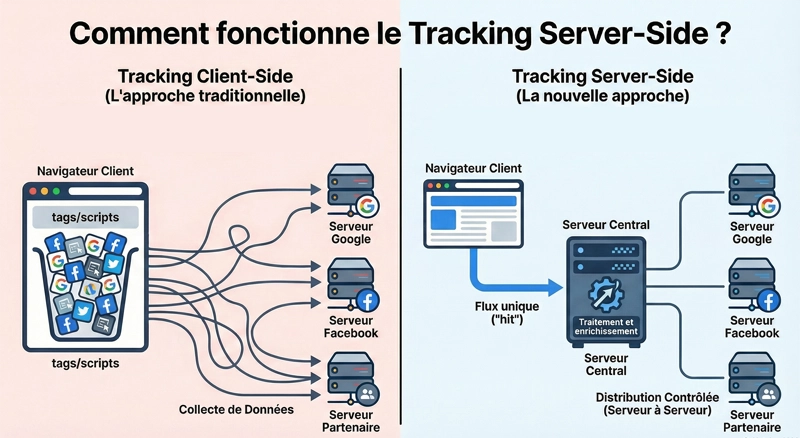
Server-side tracking vs. client-side tracking
Comparative tables for client-side vs. server-side tracking
| Features | Client-side approach (classic) | Server-side approach |
| Execution | In the user’s browser | On a dedicated server (Cloud) |
| Governance | Third-party scripts injected into site | Total control of data flow |
| Site speed | Slowed down by the multitude of tags | Optimized (single outgoing stream) |
| Reliability | Affected by blockers and ITP | Maximum (server-to-server flow) |
Strategic benefits for your digital performance
The adoption of a server-side architecture goes beyond the technical framework to become a lever for commercial growth. By regaining control over the collection process, you can directly influence the profitability of your campaigns.
Data reliability and measurement integrity
Since the data is collected from server to server, there’s no need for browser interference. The benefits are immediate:
- Bypassing ad-blockers: ad-blockers target known JavaScript scripts. Server-to-server calls are invisible to these tools, enabling the recovery of between 15% and 30% of previously lost conversion data.
- Reduced signal loss: advertising algorithms (Meta, Google, TikTok) need massive amounts of data to optimize themselves. Server-side guarantees a constant flow of data, improving attribution scores and reducing cost-per-acquisition (CPA).
By eliminating interference from ad-blockers and Apple’s ITP restrictions, server-to-server ensures that each conversion is correctly allocated to the right partner. To manage this complexity, Effinity places the Performance Center at the heart of your partner network management, offering real-time visibility on the quality of the flows collected.
Impact on loading speed and SEO
In 2026, user experience is a major pillar of SEO. Traditional tracking overloads the browser with dozens of JavaScript libraries.
- Front-end streamlining: the site server sends a single data stream. The browser no longer has to load, parse and execute scripts from each partner.
- Core Web Vitals optimization: this load reduction directly improves the LCP (Largest Contentful Paint) index and reduces the TBT (Time To Block), sending positive signals to Google for your SEO ranking.
Data security and governance
Increased security is a major asset for your domain authority (E-E-A-T). Since the data flow is centralized, you act as a filter:
- Hide sensitive data: you can remove personally identifiable information (PII) before it leaves your cloud environment.
- Third-party control: no external scripts are injected into your site, eliminating the risk of piggybacking (third-party scripts calling other scripts without your authorization) and data leakage.
Practical implementation guide: strategic support from Effinity
Key steps
- Choose server infrastructure: in-house hosting or cloud solution (e.g. Google Cloud).
- Install a Google Tag Manager server-side container (or equivalent solution).
- Configure data flows: via API or dataLayer server-side.
- Integrate a consent management platform (CMP) to remain compliant.
- Test and validate data quality before going into production.
Points to watch
- More complex technical set-up than traditional tracking.
- Hosting and maintenance costs to be anticipated.
- Need for expertise in tracking, data and RGPD.
Server-side tracking and RGPD compliance
It’s crucial to dispel a persistent myth: server-side tracking is not a method of circumventing the RGPD.
Note on compliance (CNIL/RGPD). The regulations apply to the purpose of the processing and not to the technique used. If personal data is collected for advertising purposes, the user’s prior consent via a Consent Management Platform (CMP) remains mandatory, whether the tag is client-side or server-side.
The advantage of server-side, however, lies in its ability to better respect this consent. You can configure your server to automatically block any data being sent to a specific partner if the user has expressed a refusal, guaranteeing total watertightness and flawless compliance in the face of audits.
- Data may be processed and anonymized on your server before being sent to third parties.
- You retain control over the collection process: consent, storage, retention period.
- The server-side facilitates the management of user preferences thanks to integration with a CMP.
Why work with the Effinity experts?
Implementing server-side tracking is more than just a technical issue: it’s a truly strategic decision that impacts your marketing performance, legal compliance and data architecture. With this in mind, Effinity works closely with the best solutions on the market. Find out how Commanders Act is a key cookieless partner for advertisers within the Effinity ecosystem.
Effinity’s experts can help you:
- Assess your needs and design a suitable architecture.
- Choose and configure the right tools (GTM server-side, API, CMP).
- Guarantee RGPD compliance and optimize the performance of your campaigns.
In a world where privacy protection is becoming increasingly important and browsers are limiting data collection, server-side tracking is a reliable, compliant and high-performance solution:
- A long-term solution: it offers a stable solution in the face of browser volatility and changes to Google’s Privacy Sandbox.
- Increased performance: by improving site speed and the quality of advertising signals, it has a direct impact on your ROI.
- Reinforced governance: brands regain full ownership of their data assets.
The transition requires an initial investment, but the cost of inaction (loss of data, drop in advertising performance, legal risks) is much higher today. By implementing it now, you secure your marketing strategy and prepare for the cookieless era.
Ready to switch to server-side tracking? Let’s discuss your project and build a customized roadmap.