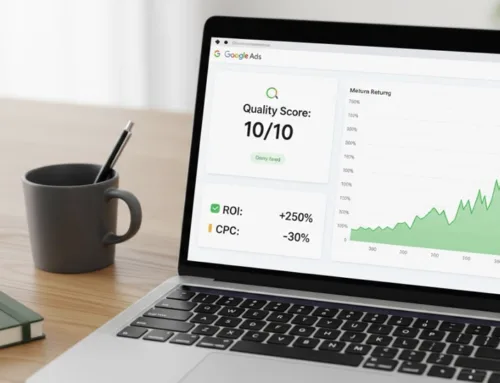

In the race for digital acquisition, every second of loading time is a lost opportunity. Lead forms are emerging as the native advertising format that eliminates the friction between a user’s interest and their transformation into a qualified lead. Designed to capture information without leaving the initial interface, they represent a major strategic opportunity for any advertising campaign seeking to maximize ROI.
What is a lead form and how does it work?
A lead form is an advertising format that collects contact data directly within a social network. Unlike traditional campaigns, the user is not redirected to an external site: the journey is entirely in-app.
Definition of native in-app advertising
The mechanism is simple: when a user clicks on your ad, a pre-filled form instantly opens. The platform uses profile data (name, email, phone) to facilitate submission. This approach eliminates landing page loading times and the risk of lost traffic.
Overview of platforms (Meta, LinkedIn, TikTok, Snapchat)
Each social network offers its own optimized version of the lead form:
- Google Ads: via “lead form extensions”, Google allows you to capture leads on the Search Network, YouTube and Discover. It’s the ultimate tool for targeting directpurchase intent.
- Meta (Facebook & Instagram): ideal for B2C and B2B thanks to ultra-precise interest-based targeting.
- LinkedIn: the standard B2B network for reaching decision-makers by function, sector or company size.
- TikTok & Snapchat: perfect for reaching a younger audience with dynamic, native mobile ad formats.
Why integrate lead forms into your acquisition strategy?
Reduced friction and a smooth user experience
The strength of lead forms lies inauto-completion. Since fields are pre-filled with verified user account information, the effort required to convert is minimal. This fluidity translates into a conversion rate that is often much higher than that of traditional landing pages.
Data reliability and economic performance (CPL)
The use of lead forms offers three major financial and technical advantages:
- Reduced CPL: by eliminating the website stage, lead volumes increase, driving down cost-per-lead (CPL).
- Email quality: the addresses collected are those used to connect to the account, guaranteeing valid contacts.
- Post-iOS 14 resilience: with data remaining within the social network ecosystem, conversion tracking is 100% reliable, without relying on third-party cookies.
How do you design a high-performance conversion form?
Balancing lead volume and qualification
The success of a campaign depends on a subtle trade-off: the more information you ask for, the higher the quality, but the lower the volume.
| Type of field | Strategic utility |
| Profile fields | Standard data (last name, first name, email) for quick contact. |
| Professional fields | Identify position, company and sector (essential for B2B). |
| Personalized questions | Precise qualification of need or budget to filter prospects. |
The golden rule: every field must be indispensable. On lead forms, there’s no such thing as an optional field. If a piece of information is not critical to your first sales contact, delete it.
Advanced targeting using signals and CRM data
In 2026, targeting will no longer be based on keywords alone, but on audience signals.
- Customer Match: import your CRM lists to find similar profiles (lookalike).
- In-Market (Google): target users identified by Google’s AI as being actively in the buying phase.
- Personalized audiences: retarget users who have opened your form without submitting it.
- Exclusion: exclude your existing customers to focus your budget on pure conquest.
Post-campaign optimization: the importance of lead processing
The technical efficiency of lead forms can be a pitfall: submission is so fluid that ad recall is sometimes poor. A prospect can forget his action within a few hours if he isn’t contacted quickly.
CRM automation and sales responsiveness
It’s imperative to automate data transfer to your management tool (Salesforce, HubSpot, etc.) via native connectors or tools like Zapier.
- The 5-minute rule: a lead contacted within 5 minutes of submission is 10 times more likely to convert than a lead processed after one hour.
Case study: success of lead forms in senior real estate
A player in the senior residence sector tested the opposition between classic landing pages and lead forms on Meta. The results demonstrate the power of the format:
- Lead volume: +80% compared to website.
- Cost per lead: 40% reduction.
- Profitability: despite a slight 10% drop in the final conversion rate, the massive gain in volume and lower acquisition costs have made the strategy much more profitable overall.
Conclusion: integrate lead forms into your acquisition mix
Lead forms don’t replace your website, they complement it. To succeed, you need to test (A/B testing), qualify intelligently and, above all, treat your leads with surgical reactivity.