
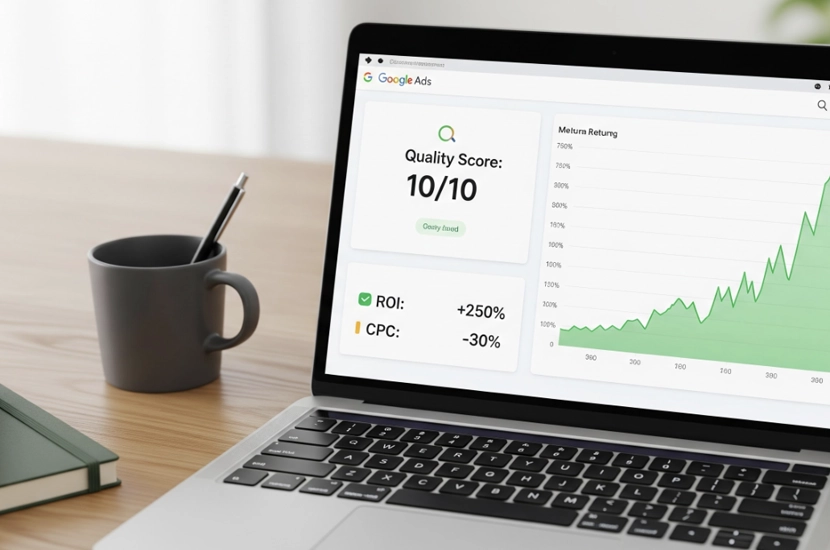
Quality Score optimization is the most underestimated lever for reducing your acquisition costs on Google Ads. Contrary to popular belief, increasing your bids is not enough to guarantee profitability.
If your CPCs are soaring while your results are stagnating, the problem lies in your “Quality Level”. This score from 1 to 10 dictates the performance of your Ad Rank. By mastering it, you don’t just participate in the auction: you dominate it mathematically, paying less than your competitors.
This technical guide explains how the algorithm works and what you can do to improve your Quality Score and boost your ROI today.
The aim of our Google Ads agency is to provide you with a detailed roadmap for understanding, analyzing and optimizing this fundamental score. By mastering Quality Score, you won’t just participate in auctions; you’ll learn to dominate them, reducing your costs and maximizing your return on investment. To begin with, it’s essential to understand how this score fits into the formula that governs the ranking of each ad: Ad Rank.
What is Quality Score? Definition and operation
Quality Score is a diagnostic metric used by Google Ads, rated from 1 to 10, to evaluate the overall quality of your campaigns. It’s not limited to your financial bid; it judges the relevance of the user experience you offer.
For Google, the equation is simple: Relevance = Profitability.
To determine your ad’s positioning, the algorithm doesn’t just use your budget, but applies the fundamentalAd Rank formula:
Ad_Rank = CPC_Max x QualityScore
In concrete terms, this mechanism is based on three analytical pillars:
- Ad relevance: Does your ad text precisely match the user’s search intent?
- Expected click-through rate (CTR): How likely is it that a user will click on your ad compared to others?
- Landing page experience: Is your page fast, clear and does it deliver the promised response?
Financial impact: a high Quality Score (7-10/10) acts as a “discount” on your bids. It allows you to appear higher in the results while paying less per click than a competitor with a mediocre score.
However, as an expert, it’s crucial to make one important nuance clear: this formula is a simplified model, perfect for illustrating the relationship between bidding and quality. In reality, the score from 1 to 10 is not used directly in bidding. True Ad Rank is calculated in real time with each new search, based on a multitude of quality signals (expected CTR, ad relevance and landing page experience, among others). The Quality Score visible in your account is an aggregated diagnostic tool, a summary of your past performance to guide you.
The Quality Score is therefore a mark assigned to a keyword, on a scale of 1 to 10. A score is generally considered good when it is greater than or equal to 7.
As Google emphasizes, Quality Score is first and foremost a diagnostic tool. Its aim is to help you identify areas for improvement in your campaigns, not to serve as a performance indicator (KPI) to be optimized at all costs.
However, this diagnostic indicator has very concrete consequences on the distribution, positioning and, above all, the cost of your campaigns.
The strategic impact of Quality Score on your performance
A good Quality Score is more than just an honorary distinction; it’s a powerful financial and strategic lever that directly impacts the profitability (ROI) of your advertising investments. Every point gained on your score translates into concrete, measurable benefits.
Cost-per-click (CPC) reduction
Google rewards advertisers who deliver a relevant user experience. A high Quality Score enables you to pay a lower real CPC for a position equivalent to, or even better than, that of your competitors. In other words, for the same Ad Rank, the higher your score, the cheaper the click. This is the most direct impact on the profitability of your campaigns.
Improved ad positioning
As demonstrated by the Ad Rank model, Quality Score is a multiplier of your bid. A high score mechanically increases your Ad Rank, enabling you to reach the top positions on the search results page, even against competitors with more aggressive bids. A higher position translates into greater visibility and a potentially higher click-through rate.
Greater distribution and visibility
Google imposes a minimum quality threshold for ad delivery. If your Quality Score is too low, your ads may not be shown at all, even if your budget and bids are sufficient. A good score ensures that your ads are eligible for delivery and reach your target audience. For more details on the budget for Google Ads campaigns, please consult our article: What is the budget for a Google Ads campaign?
Eligibility for ad extensions
Ad extensions (side links, teasers, site extracts, etc.) enrich your ads, increase their visible surface and significantly improve click-through rates. The display of these ad components is often conditional on a high Ad Rank and quality level. A good score gives you access to more effective advertising formats.
In short, improving your Quality Score means investing in the overall effectiveness of your advertising account. To achieve this, you need to focus on its three fundamental components.
The three pillars of Quality Score deciphered
To influence your Quality Score, you have three operational levers that every advertiser must master. Each of these pillars is evaluated by Google and assigned a status: “Below average”, “Average” or “Above average”. The aim is to achieve “Above average” status for each of them.
Expected click-through rate (CTR)
Expected CTR is the probability, estimated by Google, that an Internet user will click on your ad when it is displayed for a given keyword. This estimate is based on the performance history of your account and the performance of other advertisers for the same keyword.
This is the most important component of the Quality Score algorithm. For Google, a click is a strong signal that your ad is relevant and useful to the user. A high expected CTR shows that your advertising message is perfectly aligned with search intent.
To give you an idea, here are a few average click-through rates (CTR) observed on the Search Network by sector of activity.
Ad relevance
Ad relevance measures the semantic match between your keyword, your ad’s message and the user’s search intent. Google analyzes the coherence between these three elements to ensure that your ad constitutes a direct, clear and useful response to the query formulated. An ad that includes the search terms and precisely answers the user’s question will be considered highly relevant.
The landing page experience
Landing page experience is Google’s assessment of the quality and usefulness of the page the user lands on after clicking on your ad. Excellent targeting and a perfect ad are useless if the landing page is disappointing.
Key criteria evaluated by Google include :
- Original, relevant content: the page must live up to the promise made in the ad and be perfectly aligned with the keyword.
- Transparency and ease of navigation: the site must be trustworthy and easy to navigate, and contact information must be accessible.
- Fast loading time: this is a critical factor. Data shows that 53% of users leave a mobile site that takes more than 3 seconds to load.
- Mobile compatibility: the site must be “responsive”, offering an optimal experience on all screen types.
Mastering these three pillars is the basis of any effective Quality Score optimization strategy.
Concrete strategies to optimize your Quality Score
Theory is followed by practice. This section is an actionable guide to proven techniques for improving every pillar of your Quality Score. By applying these strategies, you’ll optimize not only your score, but also the overall performance and profitability of your campaigns.
Structuring your campaigns: hyper-segmentation
This method of organization is the cornerstone for improving ad relevance and, consequently, the expected click-through rate. The secret of a high-performance Google Ads account lies in its structure. Hyper-segmentation involves creating highly specific, granular ad groups to ensure maximum relevance.
The golden rule is to target 1 to 5 semantically related keywords per ad group. This approach enables you to write an ultra-relevant ad that responds precisely to search intent.
For example, instead of creating a generic ad group “women’s shoes”, structure your campaign with distinct groups such as “red leather pumps”, “white canvas sneakers” and “summer flat sandals”.
Writing high-performance ads
These techniques are primarily aimed at improving your expected click-through rate and ad relevance. The ad is the bridge between the user’s search and your offer. For it to be effective, it must be relevant and enticing.
- Integrate the main keyword: include the targeted keyword in the ad title and description. This instantly reinforces relevance in the eyes of both the user and Google.
- Use action verbs and a clear call to action (CTA): incite the user to act with powerful formulas like “Book now”, “Get a free quote”, “Discover our collection” or “Buy online”.
- Exploit ad extensions: use as many relevant extensions as possible (side links, teasers, site extracts, promotions, etc.). They increase the visible surface area of your ad, provide useful information and improve CTR.
- Practice A/B testing: systematically create at least two versions of each ad, modifying only one element at a time (title, description, CTA). This allows you to identify the messages that resonate best with your audience and continually improve your performance.
Optimizing the landing page
Every action on your landing page is aimed at perfecting thelanding page experience, the third pillar of your score. The work doesn’t stop with the click. The landing page must convert interest into action.
- Ensure perfect consistency: the message, offer and tone of your ad must be immediately reflected on the landing page. Users need to feel they’re in the right place.
- Improve technical performance:
- Compress images to reduce loading time.
- Adopt a “mobile-first” design, optimized primarily for smartphones.
- Simplify contact forms by asking only for strictly necessary information.
- Highlight reassuring elements: customer reviews, labels, guarantees, testimonials.
Precise keyword management
Precise keyword management, particularly via exclusions, has a direct impact on ad relevance by filtering out unqualified traffic. Rigorous keyword management is essential to avoid wasting budget and improve relevance.
- Use excludable (negative) keywords: this is one of the most powerful tools for improving traffic quality. If you sell new sofas, exclude terms like “used”, “free”, “repair” or “donation”.
- Keep an eye on the search terms report: regularly analyze this report to discover the exact queries typed by web surfers that triggered your ads. It’s a goldmine for identifying new keywords to exclude and refining your targeting. On this subject, read our article How to optimize targeting on Google Ads?
Quality Score optimization is an ongoing process. Regular monitoring and adjustments are the key to maintaining high scores and profitable campaigns over the long term.
Quality Score, a lever for sustainable growth
Mastering Quality Score is much more than just technical optimization; it’s a strategic philosophy that places the user experience at the heart of your advertising campaigns. As we’ve seen, this score is the real driver of performance on Google Ads.
To sum up, here are the key points to remember:
- Quality Score is the pillar of your profitability, influencing costs and positioning via theAd Rank formula.
- It’s based on three pillars: expected click-through rate, ad relevance andlanding page experience.
- Optimization requires a granular account structure, targeted ads, high-performance landing pages and rigorous management of keywords to exclude.
In reality, improving your Quality Score is not an attempt to manipulate an algorithm. It’s about creating advertising campaigns that are more useful, more relevant and more effective. A high score is only the logical consequence of a well-designed campaign that delivers real value to the surfer. By focusing on quality, you not only guarantee lower advertising costs, but also lasting success and sustainable growth for your business. And if you’re still on the fence about Google Ads, we’ve got 9 good reasons why you should start a Google Ads campaign.