Download the Affiliate marketing Barometer 2026
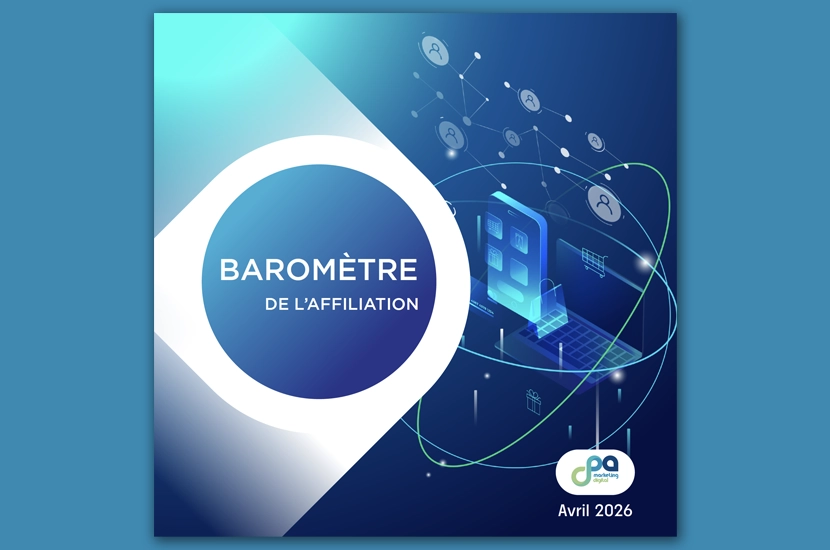
The affiliate marketing market in France is booming, as revealed by the latest Affiliation Barometer 2026published by the CPA (Collectif pour les acteurs du marketing digital). This study highlights key trends and challenges for e-commerce players. This exhaustive report, compiling key data from 10 major business sectors, offers advertisers the opportunity to assess their performance, in relation to market standards, and can guide them in developing their digital acquisition strategies. Beyond the raw statistics, these trends are reshaping the definition of modern affiliation, now more focused on value.
A fast-changing ecosystem: challenges and general trends
French affiliate marketing enters a new era in 2026. Buoyed by a robust global dynamic – the worldwide affiliate marketing market was valued at $18.5 billion in 2024 and is expected to reach $31.7 billion by 2031 (+8%) – it confirms its place as an essential lever for performance marketing.
In France, the 2025 results speak for themselves: 6,468 active advertiser programs, up +4.26% on 2024, for a stable average shopping basket of €92.57 and an average commission of 6%.
Yet beneath these generally positive figures lies a more complex reality. The market’s overall conversion rate has fallen from 1.39% in 2024 to 1.06% in 2025, and revenue per click has dropped from €1.29 to €0.98 (-24%). Average return on investment has fallen from €17.19 to €15.53 per €1 invested (-10%). The message is clear: traffic growth no longer translates mechanically into conversions. The era of volume is giving way to one of quality, relevance and profitability.
The Affiliation Barometer 2026 reveals several major trends structuring this transformation.
From bottom funnel to full funnel
Affiliation is no longer confined to cashback and coupon sites. It now covers the entire customer journey (awareness, consideration, conversion, loyalty), integrating editorial blogs, influencers, comparators and niche content. In fact, global influencer marketing reached $32.55 billion in 2025, up 35% in one year.
AI as a gas pedal, not a threat
LLMs are profoundly transforming the way consumers discover products: 40% of Gen Z now prefer AI chatbots to traditional search engines. By 2026, 58% of queries are expected to generate a “zero click” response. Publishers of quality, well-structured content are thus becoming strategic assets to be cited and recommended by AI.
Towards fairer allocation
The last-click model is gradually giving way to more holistic models, such as publisher scoring or Marketing Mix Modeling (MMM), which take into account every touchpoint in the customer journey, including those at the top of the funnel. In an article, we explain in detail how MMM can help maximize the value of affiliate marketing.
Trust as a fundamental pillar
In an environment where fraud and editorial quality are growing issues, transparency, rigorous tracking and partner selection are becoming sine qua non conditions for sustainable performance.
Key figures for affiliation in France by sector 2026
| Secteur d'activité | Panier Moyen | Commission moyenne | Taux de transformation | ROI pour 1€ Investi | Revenu / clic |
| Mode, Luxe & Accessoires | 77€ | 7% | 0,73% | 15,08€ | 0,56€ |
| Beauté, Santé, Hygiène | 61€ | 6% | 1,22% | 15,53€ | 0,74€ |
| Loisirs, Culture & Divertissement | 73€ | 6% | 0,93% | 17,43€ | 0,67€ |
| High Tech, Télécoms & Électroménager | 102€ | 8% | 1,68% | 12,12€ | 1,71€ |
| Grande consommation | 78€ | 3% | 1,49% | 30,00€ | 1,17€ |
| Sport | 73€ | 8% | 1,16% | 12,97€ | 0,85€ |
| Tourisme & Voyages | 239€ | 4% | 1,06% | 22,56€ | 2,53€ |
| Maison & Jardin / Bricolage | 115€ | 7% | 0,77% | 14,36€ | 0,88€ |
| Automobile / Moto | 99€ | 6% | 0,67% | 15,49€ | 0,66€ |
| Marketplace | 49€ | 5% | 4,27% | 20,77€ | 2,10€ |
| TOTAL | 92,57€ | 6% | 1,06% | 15,53€ | 0,98€ |
Fashion, Luxury & Accessories: a new balance between prestige and performance
With 1,496 advertisers (down slightly by -0.47%), the Fashion, Luxury & Accessories sector remains one of the most active in the French affiliate market. In 2025, 6.9 million sales were directly generated by affiliate programs in this sector, with an average basket of €77 and an average commission of 7%. Return on investment was €15.08 for every €1 invested.
Major brands, once reluctant to associate their image with promotional levers deemed “low-end”, have found their balance. Cashback and promo codes remain the undisputed champions of sales, but brands now favor highly selective partners: premium bank card benefits, private company clubs. At the same time, editorial content (fashion blogs, expert recommendations, wishlists) is emerging as the second most effective lever. Comparison sites are the third pillar, essential for capturing consumers in the active research phase.
The underlying trend? Niche content creators (exclusive fashion newsletters, TikTok, Pinterest) are set to play an increasing role in showcasing products naturally and generating qualified traffic.
Beauty, Health, Hygiene: maturity puts performance to the test
The Beauty, Health and Hygiene sector was buoyant, with 972 advertisers (+6.81%) and an average shopping basket of €61. The average commission was maintained at 6%, for a ROI of €15.53 for €1 invested. With a new customer rate of 21%, affiliation continues to play an active role in acquisition.
But the market is entering a more demanding phase of maturity. Growth is still driven by e-commerce, supported by the rise of social commerce (TikTok, Instagram), but the logic of volume is reaching its limits: the transformation rate has fallen from 1.49% to 1.22%. The challenge is shifting to traffic quality and CPA control.
Two important signals are emerging. On the one hand, the rise of CSS players and the decline of traditional cashback publishers are changing the publisher mix. Secondly, affiliation is reinventing itself as a lever for on-site activation: thanks to container tags, technologies such as Recovery Pages (recovery of up to 25% of premature exits) or Dynamic Coupon (15% reduction in promotional costs) can optimize conversion in the last few centimeters of the customer journey.
Leisure, Culture & Entertainment: strong interest, more cautious purchases
With 673 advertisers and an average shopping basket of €73, the Leisure, Culture & Entertainment sector shows contrasting dynamics. ROI is €17.43 for €1 invested, and 32% of purchases generated concern new customers for advertisers.
The market remains dynamic in terms of traffic, but the value generated is not keeping pace. Consumers are clicking more, but turning to more affordable offers. The buying process is getting longer: they compare more, wait for the right deal and take longer before validating. This caution is reflected in a drop in conversion rate (from 1.32% to 0.93%) and revenue per click (from €1.13 to €0.67, -40%).
Against this backdrop, advertisers have stepped up the attractiveness of their programs to maintain their visibility. The most effective formats remain those that provide clear, concrete information: recent visuals, budget comparisons, contextualized highlights. Wraps and special operations clearly outperform traditional banners.
High Tech, Telecoms & Home Appliances: fewer clicks, more sales
The High Tech sector is one of the most exciting in the 2025 barometer. With 789 advertisers and a stable average shopping basket of €102, sales are up by nearly 8%, even though clicks are down slightly (-2.4%). A sign of growing maturity: the conversion rate rose from 1.52% to 1.68%, and revenue per click climbed +10.4% to €1.71, one of the best performances of all categories combined.
The most striking developments have been in the decision-making levers. CSS doubled its contribution (+106% in sales), comparison shopping accelerated sharply (+31% in sales) and Influence jumped by +65%. Conversely, coupons & deals saw their sales fall by -23%: web users are no longer simply looking for a discount, but for the right purchasing decision.
The average commission remains at 8% (the highest in the market), for a ROI of €12.12 per €1 invested. With nearly 70 new advertisers in 2025 (+19% vs. 2024), competition is intensifying, and publisher commissions have risen by +14.3%.
Consumer goods: a constrained macroeconomic context
Consumer goods is the sector most affected by economic tensions. Despite an increase in the number of programs (+8%, to 284 advertisers) and strong growth in impressions (+48%) and clicks (+39%), the number of sales fell by 2.18 to 1.99 million (-9%), resulting in a drop in sales generated (from €165.5 to €156 million).
The conversion rate fell from 2.27% to 1.49%, and revenue per click dropped significantly from €1.72 to €1.17 (-32%). However, this sector has the best ROI on the market: €30 generated for €1 invested, stable compared to 2024.
This paradox can be explained by the context: despite falling inflation, households remain cautious and prefer products at controlled prices. Private labels now account for over 36% of sales by value. Against this backdrop, retail media and performance-based affiliation are emerging as levers for optimizing acquisition costs, while content-to-commerce via national and regional media is becoming increasingly important.
Sport: stability for profitability
The Sport sector remains stable in terms of sales, rising slightly from €152.4 million in 2024 to €153 million in 2025, with 374 advertisers (+6.55%). The average basket gains 3 points to €73, and profitability improves: €1 invested generates €12.97 in sales (vs. €12.54 in 2024).
Volume, on the other hand, explodes: over one billion impressions and 180.8 million clicks in 2025, compared with 127 million in 2024. This increase in traffic, unaccompanied by an equivalent rise in sales, explains the drop in the conversion rate from 1.70% to 1.16%.
The big winners of the year were Influence (sales multiplied by 2.4, from 938 K€ to 2.25 M€), Comparators (almost doubling their contribution, from 4.6 M€ to 8.2 M€) and Cashback/Reward (+5 M€). Conversely, Tech Partners suffered a drastic fall (sales halved). The outlook for 2026 points to the massive integration of influence and video, the development of ultra-qualified shopping guides and optimization for AI search engines (GEO).
Tourism & Travel: growth through value
Tourism & Travel is the fastest-growing sector in terms of number of programs: 627 advertisers, +12.97% in one year. The average basket jumped +11% to €239, the highest in the market, driving sales upwards despite a slight drop in the conversion rate (from 1.32% to 1.06%).
Growth is driven by a structural trend: over 70% of travel bookings are now made via digital channels. Purchase paths are becoming longer and more complex, with an average of 9 days between the first search and the purchase of a plane ticket, and up to 12 days for accommodation. AI tools are increasingly used to organize trips, enriching the research phase but making conversion more complex.
ROI remains attractive at €22.56 for €1 invested, and revenue per click stands at €2.59. Cashback and loyalty platforms dominate sales, while affinity and comparison sites are gaining in importance. However, the rate of new customers is very low (3%), a sign of an ecosystem where loyalty takes precedence over pure acquisition.
Home & Garden / DIY: the explosion of influence
The Home & Garden/Do-It-Yourself sector includes 989 advertisers (+6.23%), with an average basket of €115 and a commission of 7%. ROI was €14.36 for €1 invested. A highlight: 35% of purchases generated concerned new customers, the highest rate in the barometer.
The event of 2025 in this sector will undoubtedly be the explosion of Influence: +260% in sales and +300% in turnover. In the world of home decoration, embodied content (videos, role-playing) is replacing the traditional catalog. Project buying” replaces simple “price hunting”.
At the same time, on-site and anti-abandonment technological solutions have seen a 7% increase in sales and 17% in turnover: for high-carton purchases (furniture, fittings), these tools have become indispensable for guiding the surfer and finalizing the transaction. CSS and comparators remain stable, the last bastions of product visibility, provided they are fed by ultra-qualitative feeds.
Auto / Moto: digitalization and cashback to drive growth
With only 225 advertisers, but an increase of +18.42% (the strongest in the market), the Auto/Motorcycle sector experienced a remarkable acceleration. The average shopping basket is up +14% to €99, and ROI is holding steady at €15.49 for €1 invested, with 29% of new customers.
The market context is buoyant: in Europe, the automotive after-sales e-commerce market reached $32.1 billion in 2024, and should exceed $103 billion by 2034 (CAGR of 11.9%). In France, 45% of motorists now use the Internet to research, compare or purchase services and parts.
Cashback is the optimum lever in this sector, accounting on average for 35% to 45% of sales. Customers recruited via affiliation are particularly loyal, with a repeat purchase rate 21% higher than other channels. Cashback programs can increase conversion rates by at least 50% compared with conventional methods.
Marketplaces: spectacular growth, profitability to watch
Marketplaces are the most dynamic sector in the 2025 barometer in terms of growth: traffic is up +71%, sales +40% and sales +43%. With only 39 advertisers, but a conversion rate of 4.27%– by far the highest in the market – and an ROI of €20.77 for every €1 invested, they have established themselves as the main growth driver in e-commerce.
But a tension is emerging: while marketplaces’ sales are up 43%, the share redistributed to publishers is up just 9%, and average revenue per click is down 16%. This raises the question of the long-term viability of the model for publishers.
Key industry trends: retail media enhances the attractiveness of platforms; AI improves the personalization of recommendations; social commerce channels qualified audiences. The emergence of transactional “Brand-to-Brand” (brands sharing hyper-qualified audiences via order confirmation pages) has seen +100% growth on certain networks. Last but not least, the question of remuneration linked to presence in LLM responses is set to become central in the coming months.
Affiliation in 2026, a reinvented lever
This Affiliation Barometer 2026 paints a picture of a market that is maturing and reinventing itself. The major trends converge towards a single message: performance is no longer earned through volume, but through value. Quality of traffic, relevance of partnerships, richness of editorial content, mastery of attribution and integration of AI into GEO strategies: these are the new standards of performance marketing.
Affiliation in 2026 is an ecosystem in which cashback remains an essential pillar, but where influence, specialized content and comparison shopping are gaining in power. It’s a lever that goes beyond the last click to embrace the entire customer journey. Above all, it’s a deeply human discipline, where the quality of relationships between advertisers, platforms and publishers remains the cement of performance.
To explore in detail the data by sector, publishers’ opinions and strategic recommendations for 2026, download the complete Affiliation Barometer 2026published by the CPA (Collectif Pour les Acteurs du Marketing Digital) and its partner platforms. An indispensable reference document for all those involved in performance-based digital marketing in France.
A look back at the 2025 edition of the Affiliation Barometer
The year 2024 saw remarkable growth in e-commerce in France (+9.6% according to FEVAD), directly benefiting affiliate marketing. This acquisition channel has confirmed its effectiveness, with a spectacular 28% increase in the number of merchants having launched an affiliation program, representing 1,072 new players on the market. This dynamic reflects the growing recognition of affiliation as an essential performance lever.
This expansion is accompanied by a diversification of merchant profiles: Direct Brands (D2C), B2B players and niche specialists are multiplying, offering affiliates a richer and more varied range of partnerships. The cultural, sports, entertainment and home improvement sectors stand out among these new entrants, opening up specific opportunities for specialized affiliates.
With 5,000 companies now active in affiliation, the market is reaching a threshold of maturity, affirming its central role in the digital ecosystem. For more information, download the Affiliation Barometer 2025.
A look back at the 2024 edition of the Affiliation Barometer
If you’d like a comparison, you can also download the 2024 Affiliate Marketing Barometer. As a reminder, the results revealed a positive year for this channel, with strong growth from the first half of 2023, with an increase of 10% on the previous year according to the SRI (Syndicat des Régies Internet). This performance places affiliation at the top of the list of digital acquisition channels in terms of growth. By the end of the year, the affiliation market was showing annual growth of +7% compared to 2022, well above the +2% recorded the previous year. In addition, despite a slight drop in the average shopping basket from €100 to €80, the number of sales was up 37% on the previous year. Another reason for the good health of affiliate sales was the successful management of the end of third-party cookies. As a result, 2024 proved to be a record year in terms of sales generated by the affiliation channel.