
Marketing is going through a crisis of confidence. Saturated with advertising, consumers are turning away from traditional brand discourse and looking for more authentic voices. It’s in this breach that one approach has changed scale and status: gifting in influencer marketing.
Much more than simply sending products, gifting has become a strategic pillar of the influencer mix. Its strength lies in a triple convergence:
- it meets consumers’ need for confidence and social proof
- scalable thanks to technology and specialized platforms
- now structures influencer marketing strategies, particularly with micro- and nano-influencers.
At the crossroads of brand awareness, recommendation and engagement, gifting is becoming a key lever for brands. This article uses exclusive data from the first CPA and UMICC Influence Barometer to decipher the phenomenon: from its industrialized mechanics to its sectoral impact.
Definition: what is gifting in an influence strategy?
Gifting involves a brand sending a free product to a content creator, in the hope that they will test it, like it and recommend it to their community. In the context of influencer marketing, gifting ticks several boxes:
- it generates authentic content (UGC);
- it exposes the brand to qualified audiences;
- it builds trust that is difficult to achieve through advertising alone.
But what was once a time-consuming, artisanal tactic has turned into a veritable industry, driven by data and specialized platforms.
Process: how to industrialize and launch a gifting campaign in 5 steps?
Gifting has only become a marketing weapon on one condition: industrialization. What used to be a logistical “nightmare” for marketing teams is now a well-oiled performance mechanism, organized around five major stages:
Step 1: briefing: framing the gifting campaign
The brand defines its objectives (awareness, sales, traffic, etc.), the product to be promoted and the profile of the creators sought (platform, audience, centers of interest, community size) on a dedicated platform.
Stage 2: Influencer applications: a massive craze
Interested designers apply for gifting campaigns. With almost 3.8 million applications in one year, the craze for this model is massive, demonstrating its appeal, particularly among micro- and nano-influencers.
Step 3: Brand selection: from quantity to quality
The brand makes a rigorous selection of the most relevant profiles.
The average acceptance rate of 15% is not a sign of weakness, but rather a sign of the professionalization of influencer marketing: brands are no longer content to “water the market”, but are now piloting targeted campaigns with a high level of relevance.
Stage 4: content production: product fit at the heart of success
The influencer receives the product and, if convinced, creates content (post, story, video, short…) in exchange.
The 60% publication rate highlights a key point: product fit. Creators, as guarantors of their audience’s trust, don’t expose themselves with products they don’t like or understand.
Step 5: Performance analysis: measurable leverage
The platform aggregates data and provides detailed reporting on :
- range,
- interactions,
- commitment,
- the campaign’s business impact.
This logic transforms gifting into a measurable and optimizable performance lever, on a par with other digital channels.
Performance: what is the real impact of gifting (UGC) on conversion and sales?
Integrating gifting content, often classified as UGC (User Generated Content), into the marketing ecosystem directly boosts brands’ overall performance:
- Conversion: campaigns incorporating UGC achieve a +4.5% increase in conversion rate compared to those relying solely on branded content.
- Visibility: 92% of marketers report a significant increase in brand visibility thanks to gifting campaigns.
- Sales: 72% of professionals report a direct, positive impact on their sales.
- The mechanics are in place. Now it’s a question of measuring its scale: figures from the French market confirm that gifting is moving from the status of a tactic to that of a mass influencer marketing lever.
Gifting in France: volumes (views, posts) and dominant platforms (TikTok vs. Instagram)
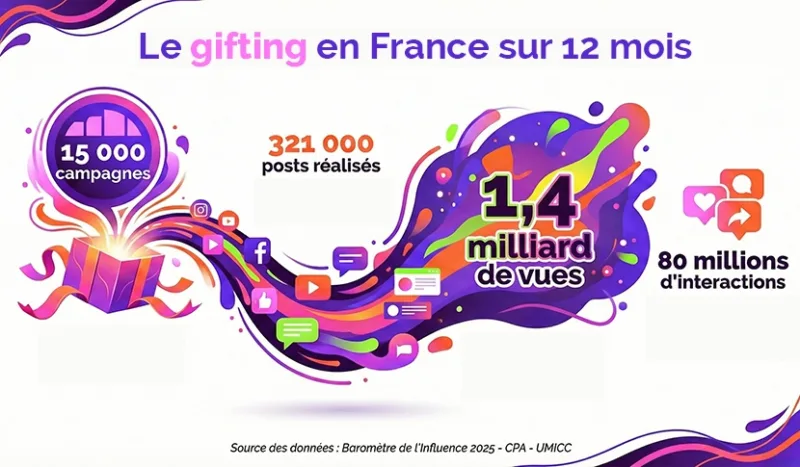
Data from the Influence Barometer show massive, organized activity. Far from being a niche practice, gifting in France has become an industry in its own right, with impressive volumes over a 12-month period:
- 15,000 gifting campaigns carried out
- 321,000 posts published
- 1.4 billion views generated
- 80 million interactions recorded
This activity is essentially focused on two platforms, which embody two philosophies of influencer marketing:
Gifting : Instagram vs TikTok
| Plateforme | Rôle dans le gifting |
| Réseau de la communauté et de l’engagement. Il génère 47 % des vues mais concentre 80 % des interactions, preuve de sa capacité à créer des conversations fortes entre créateurs et audiences. | |
| TikTok | Moteur de la viralité et de la visibilité. Avec un volume de campagnes similaire, TikTok domine en termes de portée, générant 53 % des vues grâce à un algorithme puissant, idéal pour faire découvrir de nouveaux produits. |
This is an impressive overview, but it’s only a partial one. The true richness of gifting becomes apparent when we analyze its impact sector by sector.
Sector analysis: which sectors are champions (Beauty, Food, Fashion) and where are the opportunities?
Analyzing gifting sector by sector is essential to understanding its strategic scope. Some universes have made gifting their main growth driver, while others remain under-exploited despite their strong potential.
Beauty / Health: why is it the undisputed champion of gifting?
The Beauty/Health sector is the mainstay of gifting in France:
- 80% of gifting posts,
- 75% of views generated,
- more than 10,000 campaigns over the period.
Each Beauty/Health gifting campaign generates an average of 102,000 views and benefits from an excellent interaction rate of 6.1%.
In this sector, where product testing, demonstration and social proof are decisive, gifting is no longer an option: it’s a standard part of influencer marketing.
Food and Fashion: high-potential challengers
Food: a massive attraction for designers
The Food sector is exceptionally attractive:
- 385 applications per campaign: the highest application rate of all sectors combined;
- an interaction rate of 7.2%, indicative of highly engaged communities.
Its success is due to the universality of the subject (everyone eats) and the ease of producing engaging formats: recipes, tastings, product tests, comparisons…
Fashion: low volume but record commitment
Fashion only accounts for 3% of posts, but it shines through the intensity of its commitment:
- 11.6% interaction rate, the highest of the major sectors.
As fashion is intimately linked to identity, style and personal expression, exchanges are particularly passionate, with a strong emotional bond between designers, products and communities.
Deco / DIY and High-Tech: the pillars of “surprise” performance
Some sectors, less spontaneously associated with influencer marketing, are nevertheless performing remarkably well.
Deco / DIY: the power of visual inspiration
The Deco / DIY sector stands out for its exceptional visibility:
- 192,277 views per campaign on average, the second best reach on the market.
Simple content such as before-and-after shots, location tours or DIY tutorials can go viral, driven by the highly visual and inspirational dimension of decorating.
High-Tech: when expertise rhymes with commitment
The High-Tech sector proves that gifting is not limited to lifestyle:
- 226 applications per campaign on average,
- a very high interaction rate of 9.7%.
Technical content, product tests, demos and expert opinions generate strong trust and high-quality engagement among audiences that are often highly informed.
Sport, Travel, Gaming: three sources of opportunity
Finally, three sectors appear to be under-exploited with promising indicators.
- Sport: despite a low volume of campaigns, the sector posted an interaction rate of 9.9%, revealing highly receptive communities for products tested in real-life conditions (equipment, nutrition, accessories).
- Travel: it holds the visibility record with an average of 246,493 views per campaign, proof of the evasive power of travel and experience-related content.
- Gaming: this passionate sector boasts a record interaction rate of 17.5%. Its low volume in the barometer is probably due to the weight of platforms such as Twitch and YouTube, which are often activated via tools outside the scope of the study. For brands that know how to invest in it, gaming gifting represents an exceptional source of engagement.
Gifting, a strategic influencer marketing asset for 2026
Far from being a gadget, gifting is becoming a strategic asset for brands investing in influencer marketing. The findings of the Influence Barometer point to three major trends for 2026:
A generator of authenticity and social proof
In a climate of mistrust in advertising, gifting makes it possible to produce credible UGC, embodied by identified creators, which reassures consumers and speeds up the purchasing decision.
Scalable, industrialized, measurable leverage
Thanks to platforms and data, gifting has been transformed from a manual task into a profitable performance tool. Brands can launch large-scale gifting campaigns, accurately track their results and optimize their ROI.
A strategy adaptable to each sector and objective
- target volume and contact repetition (Beauty),
- maximize engagement and conversation (Fashion, Gaming),
- search for record visibility (Travel, Deco / DIY)…
Gifting offers unique flexibility to meet very different objectives within influencer marketing.
In 2026, the line between consumer, creator and ambassador will continue to blur. Brands that see gifting as nothing more than a way of sending products will quickly be overtaken by those that use it to build a community, nurture lasting trust and make influencer marketing a genuine growth driver.
CPA/UMICC methodology: sources and scope of the 2025 study
All the data in this article comes from the “Baromètre de l’Influence – Édition Novembre 2025”, a study conducted jointly by the CPA (Collectif Pour les Acteurs du Marketing Digital) and the UMICC (Union des Métiers de l’Influence et des Créateurs de Contenu).
The study covers a 12-month period, from April 1, 2024 to March 31, 2025, and is based on:
content creators with more than 10,000 subscribers;
an audience of which at least 30% is in France;
the main social platforms: Instagram, TikTok, Snapchat, YouTube and X.