
One click, one sale, one channel credited. For years, last-click attribution has shaped dashboards, budget allocations, and affiliate partner compensation. It has one huge advantage: it provides a clear answer. But that clarity is misleading.
This is because the last click identifies an interaction recorded at the end of the measurable journey. It does not reveal what prompted the consumer to make a purchase, what made the brand stick in their mind, or what convinced them to choose it over another.
Does that mean we should do without it? No. Above all, we need to understand what it measures, what it leaves out, and how to supplement that information to better manage our investments.
What Last-Click Measurement Really Measures
Last-click
attribution involves crediting a conversion to the last eligible interaction recorded before the purchase, according to the measurement system’s rules. In affiliate marketing, this approach makes it possible, in particular, to identify the partner to whom a sale—and, where applicable, a commission—should be attributed.
That’s already a lot. The last click remains a useful operational metric for:
- Track observable behaviors: clicks, visits, and conversions associated with properly tracked interactions;
- compare campaigns using consistent attribution rules;
- Optimize conversion processes: offers, reassurance, and checkout flows;
- compensate partners based on results tracked and attributed according to the program’s rules.
However, it is important to distinguish between two things: the last recorded interaction is not necessarily the last actual interaction, and the credit attributed to a partner does not constitute proof of that partner’s causal contribution to the sale.
The last click therefore determines which party receives credit for the conversion. The problem arises when that party is asked to explain the entire decision-making process.
What the Last Click Doesn’t Know
What sparked the desire
Some of this influence takes place even before a consumer has formed an explicit intention. A video, content from a creator, or a post seen “by chance” in a feed can have a lasting impact on a future choice.
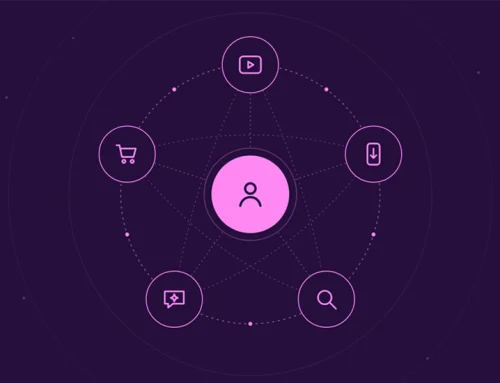
Within the framework of the 5S model for new shopping journeys (Streaming, Scrolling, Searching, Solving, Shopping), it is particularly the behaviors of streaming and scrolling that contribute to discovery, preference, and the formation of intent, without necessarily triggering an immediate conversion.
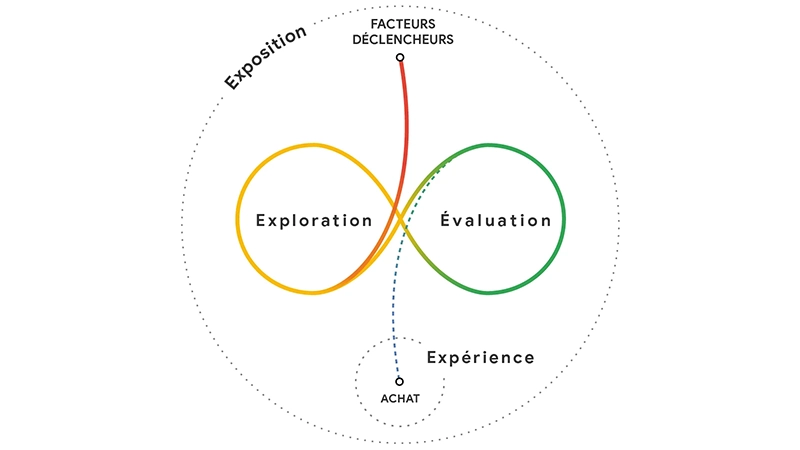
However, the decision-making process takes time. Between the first exposure to a brand and the purchase, there may be multiple touchpoints—sometimes spaced several days or weeks apart—and often without a click through to the retailer’s website. This timeframe varies significantly depending on the product, the level of engagement, and the purchasing context.
The visible purchase is therefore merely the culmination of a process, part of which cannot be tracked. Attributing the sale solely to the final event is like confusing the destination with the journey.
Touchpoints that don’t generate clicks
This phenomenon is taking on a new dimension as platforms make it possible to discover, evaluate, and sometimes purchase products without necessarily going through the brand’s website.
Search engines provide synthetic responses directly within their interfaces. Social media platforms integrate discovery, evaluation, and sometimes payment. Videos are becoming shoppable. AI assistants can help users make decisions without immediately redirecting them to an e-commerce site.
One example is “Solving”—the behavior in which a user presents a need to an AI and expects a structured response: a comparison, a recommendation, or a solution tailored to their constraints.
A brand may thus be mentioned in an AI-generated response, a recommended product, or partner content used as a source of information, without a visit being recorded on the advertiser’s website.
This does not mean that all customer journeys are now click-free. But some of the influence occurs in environments that click-based attribution tools can only partially observe.
The specific role of each partner
A creator establishes desirability. A media outlet provides credibility. A buying guide structures the evaluation criteria. A comparison site facilitates decision-making. A cashback provider reduces the final friction.
Each plays a role at a different stage of the process and produces a specific form of value.
The last click, on the other hand, is credited to a single contact. Partners involved earlier in the funnel may therefore appear less profitable in last-click reporting—not because they necessarily contribute less, but because their contribution is less directly observable or attributable.
This distinction is essential for brands: a partner that generates few directly attributable sales can still contribute to brand awareness, consideration, or preference. However, this requires metrics or methods to assess that contribution.
The share actually generated by the partner
Conversely, the partner that records the conversion is not always the one that generated the intent. A high ROI calculated based on sales attributed to the last click does not necessarily indicate an equivalent incremental contribution. Some of these purchases might have occurred even without the partner’s involvement.
This does not call into question the value of cashback or promotional codes, which can play a real role during the shopping process: helping customers make a decision, overcoming hesitation, or improving purchase terms. It simply prompts us to distinguish between two questions: how many conversions were attributed to the partner, and how many additional conversions did the partner’s involvement actually generate?
When the Last Click Leads to a Poor Decision
Let’s take a deliberately simplified example. An advertiser notices that a promotional code partner has generated 500 sales attributed to the last click over a given period. In the advertiser’s reports, this partner shows strong performance. It might therefore seem logical to increase the partner’s compensation or allocate more of the budget to them.
But what do we really know?
- What the report shows: The partner was credited with 500 conversions, in accordance with the program’s attribution rules.
- What it doesn’t show: that these 500 purchases would not have taken place without the partner.
- What it does not show: other interactions that may have contributed to the decision, such as content creators, media outlets, comparison sites, searches, or AI-generated responses.
- What needs further investigation: the partner’s specific contribution, particularly through an appropriate incrementality test.
This example is fictional, but it illustrates a real risk in campaign management. An advertiser who allocates their budget solely based on sales attributed to the last click may end up favoring the partners closest to the transaction, at the expense of those who contribute to building demand.
The problem isn’t that the last click doesn’t accurately measure what it’s supposed to measure. It’s that it’s often expected to measure something else.
Attribution or Influence: Changing the Question
The attribution logic asks: To which interaction do we attribute the credit for the sale?
The logic of influence asks: What factors contributed to the decision?
The difference may seem purely semantic. Yet it transforms the way the system is managed.
When it comes to influencing customers, simply being close to the point of conversion is no longer enough. Brands seek to understand which touchpoints captured attention, provided relevant information, built trust, or facilitated the decision to take action. This analysis does not involve artificially attributing a share of each sale to every partner encountered along the customer journey. Rather, it involves recognizing that contributions vary, that not all are directly observable, and that they cannot necessarily be evaluated using the same methods.
Complement the last click, not replace it
The goal is not to replace the last click with another “miracle” metric, but to place it within a broader measurement system.
Measuring Demand Generation
Clicks and conversions can be supplemented by metrics such as content exposure, engagement, trends in brand searches, direct traffic, or delayed conversions. In AI environments, other signals can also be tracked: brand presence in generated responses, mentions, citations of sources, or identifiable referral visits.
These metrics provide insights into a brand’s presence and observed consumer behaviors. On their own, they do not constitute proof of commercial impact. An increase in brand searches following an influencer campaign, for example, can be an interesting indicator. It does not automatically prove that the campaign caused the increase.
Combining Methods Based on the Questions
Not all measurement methods answer the same question.
| Question | Appropriate method |
|---|---|
| Which partner receives credit for the sale? | Tracking and Attribution |
| What observable touchpoints preceded the purchase? | Customer Journey Analysis and Multi-Touch Attribution (MTA) |
| Did a campaign generate additional sales? | Incremental testing |
| How do investments contribute to overall results over the long term? | Marketing Mix Modeling (MMM) |
Deterministic tracking provides data on identifiable interactions, but does not reconstruct the entire user journey.
Multi-Touch Attribution allows credit to be distributed among multiple observed touchpoints according to a given model. It does not reveal unrecorded interactions and, on its own, does not establish causality.
Incremental tests seek to measure what would have changed had a treatment not been administered, particularly by comparing groups or situations designed to be comparable.
Marketing mix modeling uses aggregated data to estimate the contribution of investments to business results, taking into account how these investments change over time and, depending on the model, external factors. Its results are estimates that depend on the data and assumptions used.
These approaches are therefore complementary. To learn more about their differences, check out our article on Marketing Mix Modeling, how it works, and its limitations.
Adapt measurement timeframes to behaviors
Not all behaviors produce effects at the same rate.
A promotional offer can trigger a quick sale. A long video or influencer content can help build brand preference that will lead to a purchase much later on.
The duration of the analysis must therefore take into account the actual purchasing cycle, the behavior being studied, and the availability of data.
In particular, it is important to distinguish between the technical attribution window—which defines the interactions taken into account when crediting a conversion—and the observation period, which allows us to study the potential effects of an activation over time.
A window that is too short may fail to capture delayed effects. Conversely, a window that is too long can complicate interpretation by increasing the number of factors that could explain the results.
Distinguishing Between Three Levels of Evidence
To avoid replacing an incomplete indicator with another misleading certainty, it is helpful to distinguish between three levels:
- Observables: clicks, attributed conversions, measured impressions, or mentions identified in AI responses.
- Estimated metrics: contributions assessed using models, user journey analyses, or statistical relationships.
- Incremental: additional effects identified through appropriate measurement methods, particularly controlled tests.
These levels are not interchangeable. An attributed conversion, an estimated contribution, and a measured incremental effect do not represent the same information.
The goal is not to generate a single ROI for each partner, but to have a body of evidence commensurate with each partner’s role and the decisions to be made.
Reconstructing a Purchase Journey
A simple exercise can help bring these limitations to life: work with your team to reconstruct a recent purchase.
What content was viewed? What searches were performed? What reviews were consulted? Did an AI assistant assist with the comparison? Which offer was ultimately used?
Then compare this journey to the available attribution reporting.
This exercise does not allow for a scientific measurement of the contribution of each interaction. However, it does highlight the discrepancies between the actual user journey and the information recorded in the tools.
What this means for your partner program
Looking beyond the last click also means changing the way you view your partners.
Rather than classifying them based solely on their immediate ROI, we seek to understand what behaviors they encompass, at what stage they can influence the decision, and in what way they contribute.
Within the 5S framework, this approach makes it possible to distinguish between partners who contribute to discovery and preference, those who provide information and credibility, those whose content can feed AI environments, and those who facilitate transactions.
In fact, the same partner can be involved at several points along the customer journey. A creator can build trust with a long-form video, spark curiosity with a short-form video, and drive a sale through a tracked link.
That is the essence of Partner Management: bringing together very different growth partners within a single framework, understanding their complementary roles, and tailoring both objectives and measurement methods to their contributions.
Performance is no longer limited to the last measurable interaction. It is built up throughout the customer journey, sometimes long before conversion.
Going beyond the last click doesn’t mean sacrificing performance. It means learning to measure all the ways in which performance is built.
To learn more, check out our “The 5S” series : four booklets (“Understand,” “Activate,” “Measure,” and “Manage”) bundled into a single package to help you adapt your partnerships to new customer journeys.