

Marketing Mix Modeling, commonly referred to by the acronym MMM, is an econometric modeling technique that measures the impact of each marketing lever on sales by analyzing historical time series data. Unlike attribution, it does not rely on tracking individual users: it models the relationships between marketing investments (TV, search, social media, affiliate marketing, etc.) and changes in revenue observed over a given period.
MMM is gradually establishing itself as a key tool for budget allocation. For marketing and finance departments, it provides a comprehensive view of how various drivers contribute to sales.
For affiliate marketing, this development represents a major opportunity. The MMM can help demonstrate the channel’s contribution beyond last-click conversion. But it also poses a risk. When affiliate data is poorly integrated or insufficiently segmented, the model may underestimate its value. A flawed statistical estimate can then lead to budget cuts, even when the program is actually driving growth. It is therefore essential to understand how affiliate marketing is represented in an MMM model.
Why is MMM important for affiliate marketing?
MMM results are increasingly being used in budget decisions made by marketing departments, finance departments, and executive committees. According to a survey by eMarketer and Rakuten Rewards of 110 U.S. marketers, 57.3% of respondents say that MMM is one of the key tools influencing their budget allocation.
For affiliate marketing, the consequences can be significant. A channel that is poorly represented in the model risks:
- to appear less involved than he actually is
- to receive a smaller budget
- to be reduced to a conversion role
- to lose visibility among decision-makers
- to see its upstream partners undervalued
Conversely, a properly powered MMM can:
- Measure the contribution beyond the last click
- highlight the upstream effects
- Uncover the cross-channel impact
- strengthen the strategic legitimacy of Partner Management
- support new investments
Why the Last Click Underestimates the Contribution of Affiliate Marketing
Affiliate marketing has historically been associated with last-click attribution. This model has one obvious advantage: it directly links a sale to a partner and a commission. But it no longer reflects the true complexity of customer journeys.
This realization has long led teams to adopt multitouch attribution models, seeking to distribute credit across each touchpoint. But these models rely on tracking individual users—a foundation that has been undermined by the deprecation of cookies and stricter privacy regulations. Cookie-less measurement is now a structural necessity, rather than a distant prospect. It is precisely in this context that MMM is regaining interest: it does not require tracking individuals to estimate the contribution of each channel.
A consumer might discover a product in a video, read a specialized article, consult a buying guide, check reviews, use a price comparison tool, return to the site via a brand search, and complete their purchase using a loyalty perk.
The last click represents only the most recent observable interaction. It does not tell the whole story of the user journey. As a result, three dimensions may be underestimated by the last-click model:
- the upstream influence of the media, creators, and partners in discovery
- The mid-term commitment that provides information and reassurance
- Cross-channel effects between affiliate marketing, social media, search, and CRM
The MMM can theoretically better capture this overall contribution. However, several characteristics of membership make it difficult to measure.
5 Reasons Why Affiliation Is Difficult to Model in an MMM
-
Investments that are often more modest
MMM makes it easier to identify the contribution of channels with large budgets. A high investment generally generates more variations, data, and points of comparison. Affiliate marketing sometimes accounts for a relatively small portion of the overall marketing mix. Even with a high ROI, its statistical impact can be harder to isolate than that of television, search, or social media. The problem, therefore, is not necessarily the level of performance; it may simply be a lack of statistical power.
-
An activity that is often ongoing
Affiliate programs are generally always active. Content remains accessible, comparison sites continue to list products, and partners generate sales year-round. However, the models learn primarily from variations.
A TV campaign that runs for three weeks and is then suspended creates a noticeable contrast. A consistent schedule results in fewer exploitable breaks.
The long-term nature of membership is one of the main reasons for its underutilization. Fluctuations do occur, particularly during promotional periods, but they are often modest compared to overall marketing investments.
-
Limited geographic segmentation
MMM models often rely on differences between regions. It is easier to measure an effect when a campaign is run in certain areas but not in others. However, many affiliate partners operate on a national scale. Content is accessible everywhere, which limits the ability to create geographic control groups.
-
Fragmented data
Affiliate marketing relies on a complex ecosystem. Data can be distributed among:
- the affiliate platform
- CRM
- GA4
- attribution tools
- the partners
- subnetworks
- tools for influence
- on-site platforms
- e-commerce systems
In the EMARKETER/Rakuten study, 33% of MMM users surveyed do not know how many affiliate sources need to be aggregated before modeling. Furthermore, 13.6% report that this data is not stored centrally.
-
Limited print data
Traditional advertising channels often provide exposure data: impressions, reach, frequency, GRP, and views. In affiliate marketing, platforms primarily report clicks, sales, commissions, and revenue. However, they don’t always have data on the impressions generated by an article, a video, a newsletter, or a comparison site. As a result, the model tracks conversions without having access to all the marketing exposure that preceded them.
Affiliation is still underrepresented in the MMMs
The problem isn’t just about the data. It also has to do with how the channel is classified. In the EMARKETER/Rakuten study, among respondents who use a MMM:
- 51.1% view affiliation as an independent channel
- 27.3% include it in a general “performance” category
- 6.8% model only certain cohorts
- 14.8% do not represent it at all
When it is grouped into a “performance” category, it becomes nearly impossible to isolate its contribution from that of search, retargeting, or other channels. But even a single “affiliate” variable remains too broad.
Why You Shouldn’t Model Affiliate Marketing as a Single Channel
The affiliate program brings together partners involved at every stage of the customer journey.
| Notoriété et découverte | Considération | Réassurance | Conversion et fidélisation |
| • médias | • comparateurs | • contenus utilisateurs | • cashback |
| • créateurs | • guides d’achat | • tests produits | • fidélité |
| • influenceurs | • CSS | • experts | • codes promotionnels |
| • newsletters | • sites d’avis | • plateformes de recommandation | • partenaires technologiques |
| • éditeurs spécialisés | • communautés | • solutions onsite |
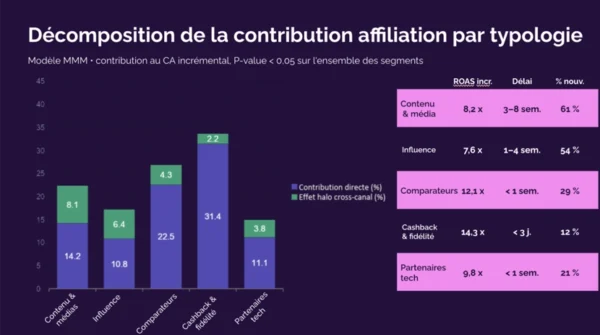
These partners do not share the same role, the same timing, or the same business model. Editorial content can influence a decision several weeks before a purchase. A cashback partner often comes into play close to the point of conversion. A comparison site may play a role at several points along the customer journey.
Combining them into a single variable introduces several biases:
- The incremental activity is lost in the average
- Upstream partners appear to be less effective
- Conversion partners dominate reading
- Deferred effects are misrepresented
- Heterogeneity reduces statistical significance
Each major group of partners should therefore be modeled separately, when volumes allow.
MMM and Affiliation: How to Interpret the P-Value
The p-value measures the statistical significance of a relationship. In an MMM:
- A p-value less than 0.05 is generally considered significant
- A value greater than 0.05 indicates that the model does not have sufficient evidence to draw a conclusion with 95% confidence.
However, a high p-value does not mean that the channel has no effect. It may reflect:
- a budget that is too small
- expenditures that are too stable
- insufficient history
- poor segmentation
- a strong correlation with other channels
- incomplete data
- incorrectly configured deferred effects
A lack of statistical significance should therefore lead to a more in-depth analysis, not to automatically cutting the budget.
How to Incorporate the Deferred Effects of Membership into an MMM
Part of the value of the relationship is built over time. A consumer may view a piece of content several times before making a purchase. A social recommendation can spark interest, followed by research, and then comparison shopping.
The eMarketer study indicates that a consumer may need to see a creator promote a product three to four times before making a purchase. The delay and decay curves should therefore be differentiated by partner.
For example:
- A promotional code has a quick but short-lived effect
- A live shopping event can concentrate its impact into just a few hours
- A video can remain active for several days
- An SEO article can influence sales for several months
- A newsletter generates a spike followed by a rapid decline
Slow update cycles and inadequate consideration of delayed effects make MMMs less actionable.
What level of detail should be used to measure attribution with an MMM?
Monthly data may mask fluctuations related to a partner activation.
A weekly or daily frequency helps to better align:
- a change in committee
- a newsletter
- a designer campaign
- a promotional highlight
- recruiting a partner
- an editorial statement
According to the EMARKETER/Rakuten survey:
- 48.9% of respondents believe that a weekly granularity would improve the affiliation signal
- 43.2% prefer daily granularity
- Only 38.7% report currently having this level of precision
For an affiliate program, a weekly payout schedule is often a good compromise.
What metrics should be used to measure affiliate performance?
Measuring attribution should not be limited to sales. A visit originating from a partner can generate revealing behaviors:
- viewing multiple products
- in-depth reading of the content
- Add to Cart
- checkout process
- increase in average order value
- a return visit to the site at a later date
- decrease in the dropout rate
It is recommended to analyze, in particular:
- the term of the contract
- navigation depth
- Responses to the incentives
- The checkout steps
- Subsequent returns
- the effect on the average cart value
This data helps us understand whether the partner:
- attracts more qualified traffic
- speeds up the decision-making process
- reassures consumers
- increases the value of the shopping cart
- influences a subsequent conversion
MMM, Attribution, and Incrementality: A Four-Layer Measurement Method
To accurately measure attribution, several levels of data must be combined.
1. Conversion Data
- sales
- orders
- revenue
- ROAS
2. Behavioral Data
- commitment
- inspection depth
- friction
- checkout
- abandon
3. Campaign Data
- clicks
- impressions
- interactions
- average shopping cart
- uplift
- Activation by Partner
4. The MMM
- channel contribution
- incremental revenue
- budgetary efficiency
- investment scenarios
Combining these four layers allows us to move from a binary interpretation (conversion or no conversion) to a comprehensive understanding of the channel’s influence.
What Customer Journeys Can Reveal
Journey analyses are an important complement to the MMM. CJ cites a study involving 400 million consumers. Journeys that included an affiliate touchpoint were associated with:
- a 92% higher visitor-to-buyer conversion rate
- a 36% increase in spending per customer
- 153% higher revenue per visitor
These results do not automatically constitute causal evidence. However, they show that affiliate marketing can play an amplifying role that is not necessarily reflected in the last click. CJ also cites a PwC/PMA study covering more than 10,000 brands, with an average ROAS of 12:1 for affiliate marketing. An MMM that concludes that the contribution is low must therefore be evaluated in light of these other metrics.
How to Integrate Affiliate Marketing into an MMM Model: 8 Key Steps
1. Map the available data
We need to make an inventory of:
- clicks
- impressions
- sales
- costs
- commissions
- cancellations
- new customers
- average shopping cart
- commitment
- CRM data
- partners
- typologies
- campaigns
2. Centralize the data
Data sources must be consolidated into a common repository. In a cookie-less measurement environment, this centralization can be achieved through secure environments such as data clean rooms, which allow the advertiser’s first-party data to be cross-referenced with that of partners or platforms without exposing individual data. This type of infrastructure is becoming a competitive advantage for programs seeking to improve the quality of their MMM signal.
3. Standardize the definitions
We need to harmonize:
- costs
- the dates
- Order statuses
- deduplication rules
- partner names
- partner categories
4. Segment the channel
The model must distinguish between the major families:
- Content and Media
- influence
- comparators and CSS
- Cashback and Loyalty Programs
- technology partners
- conversion partners
5. Document activations
An event log must include:
- hiring
- commission changes
- campaigns
- newsletters
- highlights
- promotional campaigns
- interruptions
- tests
6. Use an appropriate frequency
Weekly data is often preferable to monthly data.
7. Check statistical robustness
You need to ask:
- P-values
- confidence intervals
- variables used
- Adstock assumptions
- saturation curves
- consistency of results
- level of granularity
8. Don’t rely on a single model
The MMM must be supplemented by:
- the allocation
- analysis of career paths
- Incrementality Tests
- behavioral data
- brand research
- post-purchase surveys
Incrementality as Supplementary Evidence
The MMM estimates a contribution based on historical data. However, what it measures is still a statistical correlation, not a definite causal relationship. This is why incrementality tests have become essential as a complementary tool: they seek to measure what would have happened without the campaign, thereby isolating the channel’s true added value. The most actionable result is incremental ROAS—not the overall return on investment, but the revenue generated in addition to what would have been achieved without the campaign. An affiliate program with a high gross ROAS may thus reveal a more modest incremental ROAS if some of the conversions would have occurred anyway. Incremental tests aim to measure what would have happened without the activation.
They can take several forms:
- control areas
- exposed and unexposed groups
- holdouts
- commission variation
- Enable or Pause a Typology
- tests on new customers
- controlled campaigns
These tests help answer specific questions:
- Does the partner generate additional sales?
- Would the customer have made the purchase without him?
- Does it increase the average basket size?
- Is he recruiting new clients?
- Does it speed up the conversion?
- Does it affect the other channels?
MMM, attribution, and incremental value must therefore work together.
The Role of a Partner Management Platform
A partner management platform can play a key role in the quality of MMM. It allows you to centralize:
- the partners
- the typologies
- activations
- costs
- performance
- conversion data
- engagement data
- program histories
It can also establish a common taxonomy, document changes, and facilitate the export of data to analytics teams. But its role isn’t limited to data. Effective program management also involves:
- partner selection
- traffic quality
- the fight against fraud
- brand safety
- Brand Bidding Monitoring
- GDPR compliance
- Compliance with the law influences
- Incremental Analysis
- the development of value-creating partners
The quality of the measurement also depends on the quality of the program.
MMM, Affiliate Marketing, and AI: How to Measure Clickless Paths
Chatbots and generative AI models further complicate measurement. A response generated by AI may be based on content published by:
- the media
- comparison tools
- ;designers
- experts
- affiliate partners
The user can then make a purchase without clicking on the original source. The partner’s contribution still exists, but it is no longer visible in traditional tools. To account for these effects, models will need to gradually incorporate new signals:
- citations in LLMs
- generative voice share
- content visibility
- brand searches
- direct traffic
- brand awareness indicators
- conversions without an identifiable click
GEO is thus becoming a new focus area for partner management and marketing measurement.
MMM and Affiliation: Key Points to Remember
Marketing Mix Modeling can therefore become a strategic tool for measuring the actual contribution of affiliate marketing. Provided that partners are segmented, data is centralized, and delayed effects are factored in, MMM allows us to move beyond an analysis limited to the last click. However, it does not replace eitherattribution or incrementality testing: it is the combination of these methods that makes it possible to evaluate the ROI of affiliate marketing and properly allocate marketing investments.
| Dimension | Risque si mal géré | Action recommandée |
| Données | Sources fragmentées entre plateforme, CRM, GA4 et partenaires implique un signal incomplet pour le modèle | Centraliser toutes les sources dans un référentiel commun. Normaliser coûts, dates et statuts |
| Segmentation | Agrégation dans une variable unique, contribution des partenaires amont noyée dans la moyenne | Modéliser séparément : contenu, influence, comparateurs, cashback, partenaires technologiques |
| Granularité temporelle | Maille mensuelle : activations partenaires et pics promotionnels invisibles dans le modèle | Privilégier une granularité hebdomadaire ; quotidienne pour les temps forts à fort volume |
| Signal d'exposition | Absence d'impressions, le modèle observe la conversion sans la pression marketing qui l'a précédée | Intégrer impressions, engagements et données comportementales post-clic (durée, checkout, panier moyen) |
| Effets différés | Courbes d'adstock identiques pour tous les partenaires, contribution éditoriale sous-évaluée | Différencier les courbes de delay et decay : code promo (court), article SEO (long), newsletter (pic + déclin) |
| Activations | Sans journal d'événements, le modèle ne peut pas relier un changement de commission à une variation de ventes | Documenter : recrutements, changements de commission, campagnes, temps forts, tests, interruptions |
| Significativité statistique | P-value élevée interprétée comme absence de contribution, réduction budgétaire injustifiée | Vérifier P-values, intervalles de confiance, stabilité des résultats et hypothèses d'adstock avant toute décision |
| Triangulation | Un modèle MMM seul peut sous-estimer ou surestimer selon la qualité des données en entrée | Compléter par attribution multitouche, tests d'incrémentalité (ROAS incrémental), parcours clients et enquêtes |
| Angle mort IA | Parcours via LLM non tracés, contribution des partenaires contenu et comparateurs invisible | Intégrer citations LLM, part de voix générative, trafic direct et signaux de notoriété comme nouveaux inputs |