A consumer discovers a product in a video. A few days later, they read reviews, ask an AI assistant for help, return to a social media platform, and then make a purchase using a promotional offer. In your attribution report, only one line appears: the last click.
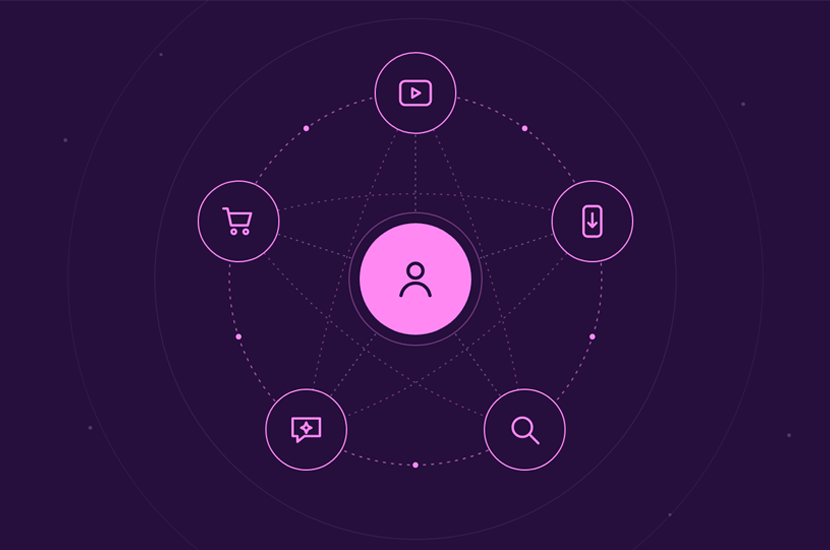
This disconnect between what consumers actually do and what brands measure is at the heart of the 5S framework : Streaming, Scrolling, Searching, Solving, and Shopping.
These five behaviors provide a better understanding of new purchasing journeys and the various stages at which a brand can influence a decision. They also encourage us to rethink the role of partners, from the initial intention through to conversion.
Why the Traditional Funnel Is No Longer Enough
Historically, digital marketing has been based on a funnel: discover, consider, compare, convert. This framework has shaped strategies, budgets, and measurement models. It remains useful for organizing certain marketing objectives. But it increasingly fails to reflect the reality of the buyer’s journey, which involves a growing number of touchpoints, back-and-forth interactions, and moments of influence.
The “Messy Middle”: Exploration and Evaluation
In 2020, Google popularized the concept of the “messy middle” to describe the space between the emergence of a need and the purchase. In its study Decoding Decisions, Google identifies two intertwined behaviors: exploration, which broadens possibilities, and evaluation, which gradually leads to a decision.
Consumers move forward, go back, discover a new option, and reconsider a brand they initially ruled out. This process can involve a wide range of content and intermediaries: search engines, creators, specialized media, comparison sites, reviews, and communities. The visible purchase is merely the culmination of a process involving multiple touchpoints, some of which do not result in a single click to the brand’s website.
Why the Last Click Doesn’t Tell the Whole Story of the Decision
The last click remains a useful operational metric. It helps identify an observable interaction that precedes the conversion and evaluate certain acquisition strategies. But it does not necessarily reveal what sparked the desire, built trust, or led to a preference for a particular brand.
This limitation becomes more significant as interactions become more diverse. Search engines can provide an answer directly within their interface. Videos and social media posts can include shopping features. AI assistants can help users make decisions by offering recommendations, with or without linking to an external website.
This does not mean that clicks are disappearing, nor that all user journeys are becoming click-free. Traditional search and visits to e-commerce sites remain essential. However, some of the influence may now be exerted in environments that traditional attribution models only partially capture.
It is therefore no longer just a matter of determining which channel generated the conversion, but also which touchpoints contributed to the decision-making process. This distinction between attribution and contribution is central to discussions about Marketing Mix Modeling as applied to affiliate marketing.
What are the 5Ss of the new customer journeys?
In January 2025, the Boston Consulting Group (BCG) proposed a new framework for understanding the customer journey based on four behaviors: Streaming, Scrolling, Searching, and Shopping. This model, presented in the study *It’s Time for Marketers to Move Beyond the Linear Funnel*, was subsequently adopted and popularized by Google.
To incorporate uses related to generative AI assistants, Effinity proposes expanding this framework to include a fifth behavior: Solving.
The 5Ss do not describe five successive steps or five distinct channels. They represent five ways of acting: consuming content, discovering, searching, delegating the fulfillment of a need, and purchasing. These behaviors can occur in any order, repeat themselves, or be combined during the same customer journey.
Streaming and Scrolling: Discovering and Shaping Preferences
Streaming refers to an immersive way of consuming content: long-form videos, podcasts, live streams, or on-demand programs.
These formats make it possible to develop a narrative, showcase a product in a real-world setting, and gradually build trust. A product review on YouTube or a recommendation in a podcast can influence a decision long before a consumer even begins searching online.
Scrolling is more like digital window shopping. On Instagram, TikTok, Pinterest, or other platforms, consumers browse a stream of content without necessarily looking for a specific product.
Attention is more fragmented, but opportunities for discovery are multiplying. A short demonstration, an inspiring post, or a recommendation from a creator can spark interest or prompt action.
Streaming and scrolling thus play a role in shaping purchase intent. Their contribution can be decisive, even when no immediate conversion is recorded.
Searching: Search, Compare, and Confirm
Through ” Searching,” consumers actively seek information to answer a question, explore options, or make a decision.
They can use a search engine, a price comparison site, read reviews, consult buying guides, watch demonstration videos, or ask an AI assistant.
Research often formalizes an intention that has already been partially developed. It allows us to compare characteristics, verify a brand’s credibility, or choose between several solutions.
For brands, the challenge is to establish a presence in the environments where this decision-making process takes place—either directly through their own channels or through relevant third-party sources.
Solving: Having AI Generate an Answer or a Solution
” Solving ” refers to a behavior in which the consumer delegates part of the analysis, problem-solving, or decision-making process to an AI assistant.
Rather than conducting numerous searches and comparing different pieces of content on his own, he articulates a broader need and expects a well-thought-out response that takes several constraints into account.
The assistant can summarize information, compare solutions, make a recommendation, or assist with planning an action.
For a brand, the challenge is therefore no longer just about appearing in a list of results. It’s also about being accurately represented in the information that AI systems can draw upon to generate their responses.
Brand content, specialized media, guides, comparison reviews, and industry experts can all contribute to this information environment. However, their presence does not guarantee that they will be selected as a source or cited in a generated response.
Shopping: Making Decisions and Purchases Easier
Shopping refers to the act of making a purchase and the interactions that facilitate the transaction.
Visible offers, reassurance, promotions, cashback, customer reviews, product availability, or payment options can help eliminate the remaining barriers to purchase.
This behavior does not necessarily represent the final step in a long journey. In social commerce, a video or a post can spark discovery and lead to an almost immediate purchase.
The ability to convert must therefore be considered across different environments, not just at the end of a traditional funnel.
Searching and Solving: What Are the Practical Differences?
The distinction depends less on the tool used than on what the consumer expects from the interaction. Take, for example, someone planning a hiking trip.
In the Search section, she can search for “best backpack for a three-day hike,” check out comparisons, read reviews, and look up the specifications of various products.
In Solving, she can ask an AI assistant: “I’m going on a three-day hike in the mountains, on a limited budget, and there’s a chance of rain. Help me pack my gear, identify the important factors, and choose a suitable backpack.”
In the first case, the consumer seeks information to help make a decision. In the second, the consumer delegates part of the analysis and expects a proposal tailored to their specific situation.
These two types of behavior can overlap. An AI assistant can be used to perform a simple search, while a search engine with generative capabilities can help solve a complex problem.
Solving, therefore, does not replace Searching. It helps distinguish a shift in behavior: moving from searching for information to the guided development of a solution.
How the 5S Approach Is Changing Brand Strategy
The main contribution of the 5S framework is that it shifts the focus of the question. We no longer ask only where the prospect is in the funnel, but what they are doing, what need they are trying to fulfill, and who might be influencing their decision at that moment.
Moving from channel-based reach to behavioral coverage
For brands, this shift means rethinking their digital presence. In practice, this calls for:
- be present before the search begins, at the stage where attention and preference are formed;
- develop relevant content and partnerships in the environments where consumers seek information, compare options, and use AI;
- facilitate access to products and conversions, including in social commerce environments;
- identify behaviors that are not adequately addressed by their systems;
- rebalance, where appropriate, investments between creating demand and capturing existing demand.
No single channel covers all of these behaviors on its own. The challenge is no longer simply a matter of choosing between SEO, advertising, influencer marketing, or affiliate marketing, but rather of coordinating how they complement each other and understanding the roles of the various stakeholders involved in the decision-making process.
Tailor the measure to the various contributions
Not all behaviors generate the same signals. A long video can build brand awareness without generating an immediate click. A price comparison site can drive a measurable visit. A cashback partner may come into play just before the transaction.
In AI environments, a brand may appear in a response, be mentioned without a link, be associated with a cited source, or receive a referral visit. These situations represent different observations, none of which, on their own, demonstrate commercial influence.
Tracking clicks and conversions therefore remains useful, but—depending on the objectives and available data—it is best supplemented by analyzing assisted conversions, conducting incrementality tests, using marketing mix modeling, or examining presence metrics in AI responses.
The challenge is not to artificially assign a value to each contact, but to distinguish between what is directly observable, what can be estimated, and what remains uncertain.
How Partners Implement the 5S Method
Creators, influencers, specialized media outlets, comparison sites, buying guides, communities, newsletters, cashback providers, and marketplaces all play a role at different stages.
A designer can create appeal. A specialized media outlet provides information and credibility. A comparison site makes it easier to choose. A cashback provider can help reduce the final hurdles before a purchase.
But a single partner can also cover multiple types of engagement. A video creator can engage users through streaming with in-depth content, scrolling with short-form content, and even shopping via a tracked link or an integrated purchase feature.
So the right question is no longer “Which category does this partner belong to?” but “What behaviors does it cover, and what is its contribution?”
Which partner profiles correspond to which behaviors?
| Comportement | Partenaires pouvant intervenir | Contribution possible |
| Streaming | YouTubeurs, podcasteurs, streamers | Expliquer, démontrer, construire la confiance |
| Scrolling | Influenceurs, créateurs sociaux, communautés | Inspirer, faire découvrir, susciter l'intérêt |
| Searching | Comparateurs, médias spécialisés, guides d'achat | Informer, comparer, rassurer |
| Solving | Médias experts, guides spécialisés, éditeurs de contenus de référence | Fournir des informations pertinentes susceptibles d'être mobilisées par les IA |
| Shopping | Cashback, sites de codes promotionnels, marketplaces, partenaires de social commerce | Faciliter la transaction et lever les freins |
This mapping is not exhaustive: a partner may be involved in multiple behaviors, and its contribution depends, in particular, on the content produced, its audience, and the context in which it is viewed.
It is this shift in perspective that leads us to view Partner Management as a process for steering the partner ecosystem, rather than simply managing campaigns or channels.
An example of a multi-partner journey
Let’s imagine a brand that specializes in hiking gear. A consumer discovers a backpack in a YouTube video created by a niche content creator. A few days later, an Instagram post reminds them of that product. When they start planning their trip, they consult a comparison guide published by an outdoor media outlet. Then they ask an AI assistant to help them pack based on the length of their trip, the weather, and their budget.
The assistant can draw on various available sources of information—which may come from specialized guides—without necessarily citing all the sources consulted. Ultimately, the consumer purchases the bag by taking advantage of a promotional offer from a partner.
In this illustrative scenario, several stakeholders may contribute to the decision:
- The YouTube creator introduces the product and builds trust;
- Social media posts keep people engaged;
- Specialized media provide points of comparison;
- Information available from third-party sources may contribute to the response generated by the AI;
- The promotional partner helps drive conversions.
The last click might be credited to the promotional partner. However, it alone would not be enough to determine the influence of the other touchpoints.
It is precisely this complementarity that the 5S method makes it possible to map out.
How do you conduct an initial 5S assessment of your program?
For a brand, the value of the 5S framework extends beyond simply providing a better representation of the customer journey. This framework can also be used to analyze its partner portfolio and identify opportunities for growth.
An initial assessment can be structured around four questions.
-
Which partners currently make up your ecosystem?
Make an inventory of creators, media outlets, comparison sites, communities, promotional partners, and other active partners. For each one, identify the content, formats, and environments in which they operate.
-
What types of behavior do they actually cover?
Match each partner with the S areas in which they can contribute. Don’t limit yourself to their category: a specialized media outlet can contribute to “Searching” through its comparison reviews and to “Solving” when its content serves as a relevant information source for AI assistants.
This possibility does not mean that he will actually be mobilized or drafted.
-
Where are the blind spots in your program?
A portfolio focused on comparison sites and cashback primarily covers certain stages of the search and shopping processes. It may leave less room for partners that contribute to discovery, preference, or actionable information in AI environments.
The goal is not to seek identical coverage of the five behaviors, but to identify gaps between your strategy, your markets, and your existing portfolio.
-
Which partners should we prioritize in terms of engaging or developing relationships with?
Identify profiles that can help boost underrepresented behaviors, then evaluate these opportunities in light of your objectives, audience quality, available resources, and measurement criteria.
This initial assessment can lead to a simple overview: existing partners, behaviors covered, expected contributions, available evidence, and priorities for implementation.
Four booklets to help you learn more and take action
The series “Partnership Marketing in the Age of New Customer Journeys” explores the 5S framework from four complementary perspectives, all brought together in a single package.
| I - Comprendre : les marques face aux nouveaux parcours d'achat | II - Activer : affiliation et partenaires, couvrir les nouveaux parcours | III - Mesurer : de l'attribution à la contribution réelle des partenaires | IV - Piloter : Partner Management, transformer un réseau en écosystème de croissance |
 |
 |
 |
 |
| La fin du parcours linéaire, le messy middle, la différence entre attribution et influence, et le détail de chacun des cinq comportements. | Quels partenaires pour chaque S, une grille d'audit et cinq étapes pour aligner un programme d'affiliation sur les 5S. | Les temporalités propres à chaque S, le rôle du tracking, du multi-touch, de l'incrémentalité et du MMM, ainsi que les nouveaux signaux liés aux IA. | Sortir du pilotage en silos, consolider une vue partenaire unique et cartographier son écosystème. |
Where should I start?
Here’s a simple exercise: Reconstruct your most recent purchase. What content did you view? What searches did you perform? What reviews did you read? Did you use AI to compare options or solve a problem? Which offer did you ultimately use? You may find that the last click tells only part of the story.
Next, do the same exercise with your partner program: What behaviors does it already cover? Where are its blind spots? Which partners could help fill those gaps?
That is the goal of the “5S Mapping of Your Program” initiative offered by Effinity.
To discuss 5S implementation in your ecosystem, contact the experts at Effinity.