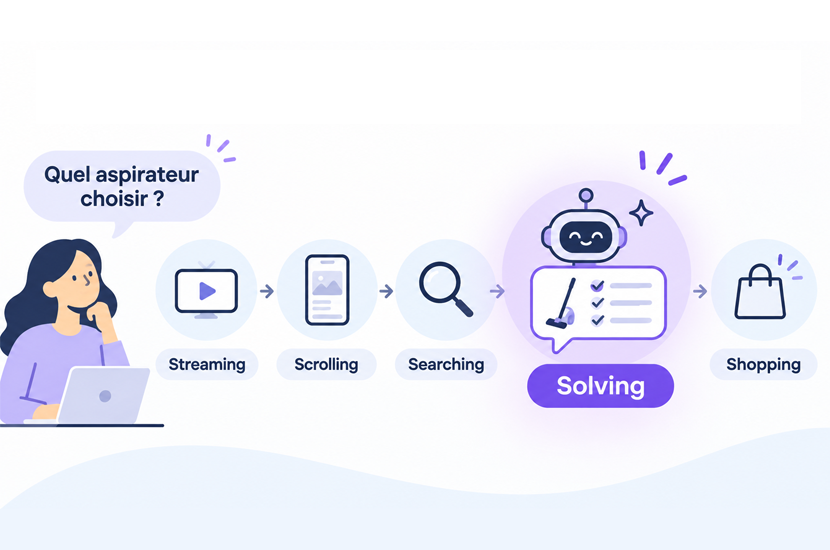
“Which vacuum cleaner should I choose for a small apartment with a cat, without going over my budget?”
Not long ago, answering this question meant doing a lot of research, checking out comparison guides, and reading reviews. Today, consumers can ask a generative AI directly, which helps them define their criteria, compares several options, and offers a recommendation.
This behavior, which we call “Solving,” is transforming the way consumers discover products and make decisions.
To address this, Effinity proposes expanding the Boston Consulting Group’s 4S framework to include a fifth behavior. This evolution changes not only the visibility challenges for brands but also the contribution of their partners.
From BCG’s 4S to the 5S: A New Behavior Emerges
In 2025, the Boston Consulting Group (BCG) developed a new framework for understanding the customer journey based on four behaviors, which were also highlighted by Google:
- Streaming: watching videos and audiovisual content.
- Scrolling: exploring content on social media and recommendation feeds.
- Searching: looking for information, products, or solutions.
- Shopping: exploring product offerings and making purchases.
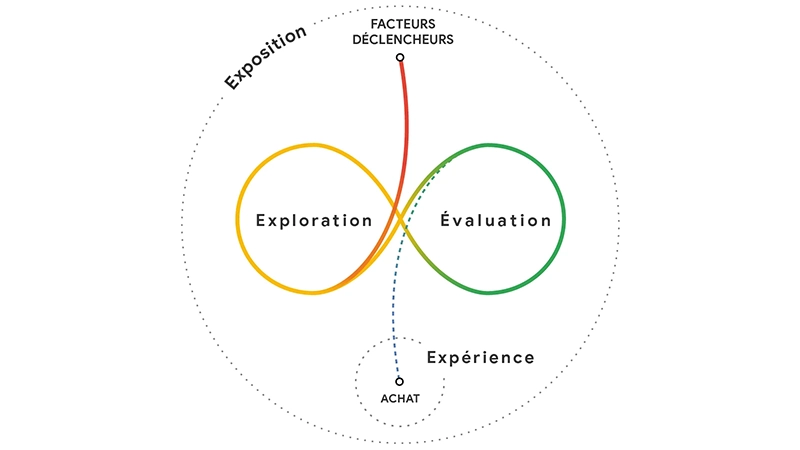
These 4S do not represent successive stages of a conversion funnel. They describe behaviors that can be combined, repeated, and influence decision-making at different points in time.
BCG therefore suggests thinking in terms of “influence maps” rather than standardized customer journeys. The key is not just to identify touchpoints, but to understand their role in shaping preference and choice.
With the rise of generative AI, Effinity proposes adding a fifth behavior: Solving, which involves delegating part of the research, analysis, or decision-making to an AI.
The framework used to map out the purchasing journey is thus the 5S model: Streaming, Scrolling, Searching, Solving, and Shopping.
What is “Solving” in the customer journey?
“Solving
” involves providing an AI with a need, a problem, or a goal—often accompanied by specific constraints—to obtain a structured response.
Consumers don’t necessarily ask where to find information. They expect help in solving their problem.
For example, they can ask an AI to clarify their needs, compare different solutions, prioritize their criteria, or recommend a product suited to their situation.
Let’s go back to the example of the vacuum cleaner.
Users can specify the size of their home, their budget, whether they have a pet, and their noise preferences. The assistant can then identify the important criteria, compare several models, and explain their advantages and limitations.
This approach is already exemplified by the shopping search tools developed by OpenAI, which combine clarifying questions, information searches, and product comparisons.
The major change, therefore, does not lie solely in how information is accessed. It lies in the extent to which consumers are willing to delegate the work of researching and evaluating information .
Searching or Solving: What’s the Difference?
The two behaviors are closely related, but they reflect different intentions.
Searching: Finding and Exploring Information
Searching involves looking for information to discover a product, verify a feature, read a review, or compare options.
The consumer reviews the results and can continue the analysis on their own to make a decision.
For example, he is trying to answer the question: “Which vacuum cleaners are best suited for small apartments?”
Solving: Delegating the Formulation of a Response
In Solving, the consumer asks an AI to organize the available information, take their constraints into account, and help them weigh different solutions.
Her question becomes: “Which vacuum cleaner would be best for me, given that I have a cat, limited space, and a budget of 250 euros?”
The distinction does not depend on the tool used.
A Google search can be considered “Solving” when an AI-generated answer helps solve a complex problem. Conversely, a simple question asked of ChatGPT can be considered “Searching.”
The key factor is the degree of delegation.
“Searching” allows you to find and explore information. “Solving” helps you develop a solution. “Shopping” then allows you to explore commercial offers and make a purchase.
These behaviors do not constitute a mandatory path. Consumers can switch from one to another, change their minds, or consult multiple sources.
AI: The New Intermediary Between Consumers and Brands
This is the main consequence of “Solving”: AI no longer merely facilitates access to information. It can also help interpret that information and formulate recommendations.
It can potentially come into play as early as the needs assessment phase, when exploring solutions, during the comparison phase, or as the purchase approaches.
Some of this influence occurs without a click
Consumers may encounter a brand in a generated result without ever having visited its website. Conversely, they may receive an unfavorable recommendation or never see certain offers, even if they are relevant.
Some of that influence can thus be exerted even before any identifiable visit takes place.
Web traffic and attributed conversions remain essential. But they alone are not enough to reconstruct the entire decision-making process.
Solving highlights a limitation that already exists in nonlinear user journeys: being influential does not necessarily mean being the source of the last click.
For brands: simply being found is no longer enough
In a traditional search-based journey, a brand seeks, among other things, to appear in the results viewed by the consumer.
With “Solving,” it must also be identifiable as a relevant solution to a specific need.
This requires several additional conditions:
- provide reliable, accurate, and up-to-date product information;
- explain the uses, benefits, and limitations of its solutions;
- be featured in specialized and credible content;
- enable consumers to easily verify a recommendation and proceed to purchase.
Let’s take a vacuum cleaner manufacturer as an example.
A product description that lists only the power and price does not necessarily address questions about pet hair, small areas, and noise level.
A detailed comparison, a user guide, or an independent review may provide information that is more directly relevant to this question.
This does not guarantee that the brand will be recommended by an AI. However, this content enriches the information available to explain the products’ features and uses.
GEO: Boosting a Brand’s Presence in AI Responses
GEO, or Generative Engine Optimization, refers to approaches aimed at improving the presence and representation of an entity, a brand, or its content in
the
responses of search engines and assistants that use generative AI.
This approach builds on certain fundamental principles of SEO: content quality, clarity of information, accessibility, reliability, and relevance to users’ needs.
It also encourages an examination of the contexts in which the brand is described, compared, or recommended.
Presence, citation, and influence: three concepts to distinguish
We must distinguish between several phenomena:
- Being mentioned: The brand appears in a response generated by AI.
- Being cited as a source: Content associated with the brand, or published by a partner, is explicitly referenced in the response.
- Influencing a decision: Information effectively contributes to the consumer’s preference or choice.
These three situations are not equivalent.
Depending on the tools and features, AI responses may be based on web content, product data, specific integrations, or the model’s knowledge.
The absence of a citation therefore does not allow us to conclude that there was no influence, just as a citation alone does not prove a commercial contribution.
The goal is to improve the quality of the information available about the brand and then observe how it appears in responses relevant to its customers.
Partners also become sources of authority
This change directly affects growth partners.
A specialized media outlet, a buying guide, a comparison site, an industry expert, or a YouTuber can help consumers learn about and understand a product.
Some of their content may also be accessed or cited by AI systems when they are answering a relevant question.
Let’s go back to our example.
A partner has published a detailed guide on vacuum cleaners suitable for pet owners. It compares the features, usage scenarios, limitations of each model, and selection criteria.
This content may attract a user looking for a comparison, help them make a decision, and serve as a source of information that an AI assistant could draw upon.
For a brand, the value of this partner is therefore not necessarily limited to the traffic it drives or the sales directly attributed to it.
Audience Partners: Driving Traffic and Conversions
Audience
partners
help boost a brand’s commercial visibility, drive qualified traffic, and can lead to directly measurable conversions.
Their contribution is typically tracked using metrics such as traffic, leads, sales, or attributed revenue.
Authoritative Partners: Helping You Make an Informed Choice
Authoritative
partners
provide expertise, analyses, comparisons, and recommendations that help you understand and evaluate an offer.
Their content can also contribute to a brand’s representation in the responses generated by AI.
Their value, therefore, does not depend solely on their ability to generate an immediate visit or sale.
These are not mutually exclusive categories. The same partner can fulfill both roles.
This approach broadens the perspective on the partner portfolio: in addition to observable business results, it also considers potential contributions to visibility, trust, and building brand preference.
How can you incorporate Solving into your partner strategy?
An initial approach can be organized around three complementary steps.
Identifying the questions consumers ask AI systems
The goal is to identify the needs, constraints, and trade-offs that may lead a consumer to use a conversational assistant.
These questions are not limited to queries directly related to the brand name or its products. They may concern problems to be solved, real-world scenarios, or comparisons between different solutions.
Analyze the brand’s presence and the sources cited
Based on a documented set of questions, it is possible to examine the
brand’s
presence, the recommended competitors, the arguments used, and the sources cited.
These observations must be repeated and put into context: responses may vary depending on the tool, the timing, and the wording of the question.
Mapping Influential and Authoritative Partners
The next step is to identify the media outlets, experts, comparison sites, and content creators who produce relevant content on topics related to the brand.
The goal is to bring together two perspectives that are still often viewed separately: the directly measurable performance of partners and their potential contribution to the moments when consumers make their choices.
Presence indicators in AI responses thus complement tracking and methods for evaluating contribution. They do not replace the measurement of business results and do not, on their own, constitute proof of incrementality.
From Solving to Partner Management
: The addition of Solving to the 4S framework broadens the way brands approach their partnerships.
The question is no longer just about which partners drive traffic or generate sales.
It also becomes: Which partners help raise awareness of, promote understanding of, facilitate comparison of, and assist in choosing our brand across all new purchasing journeys?
It is within this framework that Effinity approaches Partner Management: identifying, engaging, and managing an ecosystem of partners whose contributions can occur at different stages and take various forms.
To explore this topic further, check out our series of four booklets on the 5S method: Understanding, Implementing, Measuring, and Managing.