ChatGPT Ads has been available in France since August 24, 2026. With the introduction of advertising in ChatGPT, brands now have a new channel to reach consumers as they search for solutions, compare products, or prepare to make a purchase decision. How does ChatGPT Ads work? What are the ad formats, targeting options, and performance metrics? And what’s the difference between ChatGPT Ads and GEO Ads? Our ad agency has taken a close look at this new advertising platform and broken it down for you.
Following an initial pilot launched in the United States in February 2026, OpenAI expanded ChatGPT Ads to 31 European markets, including France, on August 24, 2026. At launch, ads can be shown to users of the ChatGPT Free and Go plans. The Plus, Pro, Business, Enterprise, and Edu subscriptions remain ad-free.
But the stakes go far beyond simply launching a new advertising platform. With ChatGPT Ads, advertising enters an environment where users no longer simply enter a query. They describe a situation, outline a problem, specify their constraints, compare solutions, and gradually refine their decision. It is this rich context that makes advertising on ChatGPT a channel that is potentially different from traditional Search Ads.
What is ChatGPT Ads?
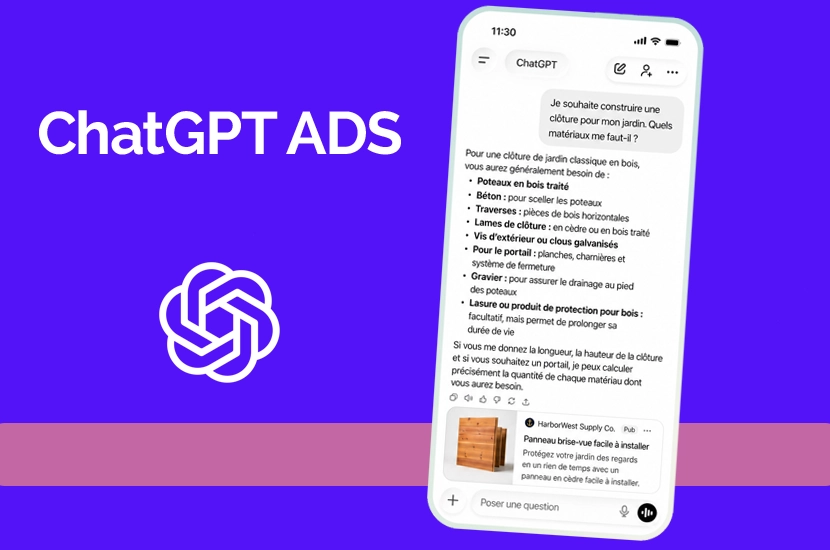
ChatGPT Ads is OpenAI’s advertising platform that allows advertisers to run sponsored ads in ChatGPT. The ads appear separately from the AI-generated responses and are selected based on factors such as the context and intent of the conversation.
In other words, a brand does not pay to be mentioned or recommended by ChatGPT. Instead, it purchases an ad slot near a conversation in which its product or service may be relevant. This distinction is key to understanding ChatGPT Ads—and, in particular, how they differ from GEO.
Why is ChatGPT becoming a strategic advertising platform?
ChatGPT has gradually evolved into more than just a tool for quickly obtaining information. It is now involved in many decision-making processes.
A consumer may request the following in succession:
- how to solve a problem
- What solutions are available?
- What criteria should be considered?
- Which products to compare
- Which product should I choose?
- where to buy it
ChatGPT thus becomes a space for shaping preferences and making decisions. Conversations related to purchasing can take place very early in the customer journey: defining a need, discovering a product category, comparing options, evaluating a specific product, and then preparing for the purchase.
For advertisers, this feature is essential. On a search engine, advertising typically appears after a relatively specific query has been entered. In ChatGPT, it can potentially appear while that query is still being formulated.
Where do ads appear in ChatGPT?
ChatGPT ads are clearly labeled as sponsored and appear separately from the response generated by ChatGPT. Advertisers cannot pay to modify or influence the AI’s responses.
This separation is one of the fundamental principles of OpenAI’s advertising model. A conversation may therefore very well include:
- an organic result that mentions Brand A;
- followed by an ad for Brand B located below that answer.
Ad visibility and organic visibility are two different mechanisms. This is precisely why ChatGPT Ads and GEO complement each other.
How does ChatGPT Ads targeting work?
Targeting is likely the most significant difference between ChatGPT Ads and traditional keyword-based advertising platforms. On Google Ads, a large part of the search strategy relies on the queries entered by users.
In ChatGPT Ads, the system can take into account the context and intent of the conversation to determine the relevance of an ad. OpenAI considers several signals, including:
- the context of the conversation
- detected intent
- the landing page
- the headline and ad copy
- the targeting parameters set by the advertiser
- “context hints”
- and, when ad personalization is enabled, certain signals derived more broadly from the user’s ChatGPT experience
The challenge, therefore, is no longer simply to identify keywords. It is to understand in what situations an offer becomes relevant.
From Keywords to Conversational Context
Let’s take the example of a manufacturer of robot vacuum cleaners. A search strategy might aim to target a query such as:
“best robot vacuum”
In ChatGPT, the conversation can start much earlier:
“I work all day, and I have a dog that sheds a lot. How can I keep my apartment clean without vacuuming every night?”
The need that has been expressed is extremely wide-ranging:
- the presence of an animal;
- hair-related issues;
- lack of time;
- automation research;
- home environment.
The product hasn’t even been mentioned yet. That’s precisely the point of conversational targeting: understanding the problem and the decision-making moment, not just the final query.
What are context hints in ChatGPT Ads?
Context hints are descriptions provided by the advertiser to explain the conversations, topics, or situations in which their offer is particularly relevant.
For our robot vacuum, a context hint could, for example, be:
People who own a dog or cat and are looking for an automated solution to reduce pet hair and keep their home clean.
Or:
People who have little time to spend on housekeeping and are looking for appliances that can automate certain household chores.
When building a ChatGPT Ads campaign, the key question is therefore:
“In which conversations do we want our brand to be present?”
This approach could become one of the key methodological changes brought about by conversational advertising.
Can ChatGPT Ads be used to attract new customers?
Yes, and that’s probably one of its main advantages. A ChatGPT ad can appear even if the user hasn’t mentioned any brands yet. Therefore, the channel shouldn’t be viewed solely as an equivalent to Brand Search.
Let’s look at a complete course:
Step 1 – Problem
“How can I keep my apartment clean with a cat when I work all day?”
Step 2 – Discovery
“Is a robot vacuum really effective at picking up pet hair?”
Step 3 – Consideration
“What factors should you consider when choosing a robot vacuum?”
Step 4 – Evaluation
“Which robot vacuum should I choose for a 70 m² space with hardwood floors and carpets?”
Step 5 – Purchase
“Where can I buy this model with fast shipping?”
A single brand may benefit from appearing at several of these stages, with different messages. ChatGPT Ads can thus serve as a tool for discovery, consideration, preference, and conversion.
Is ChatGPT Ads a full-funnel advertising platform?
ChatGPT Ads does indeed follow a full-funnel approach, as the conversations cover different stages of the customer journey.
Defining the Need
The user is trying to solve a problem without necessarily knowing the solution. The brand must therefore focus on the need and the benefit.
Discovery
The user begins exploring different categories of solutions. The ad may present an approach or a value proposition.
Comparison
Several options are being considered. Advertising can highlight the product’s unique selling points: performance, features, price, warranty, or services.
Evaluation
The user is interested in a specific product or offer. Evidence, features, and reassurances become essential.
Purchase
The message may take on a more transactional tone: price, availability, promotions, shipping, or terms and conditions.
This diversity has an important implication: a ChatGPT Ads campaign should probably not rely on a single creative. The message must be tailored to the context and the user’s level of maturity.
What are the ad formats available for ChatGPT Ads?
The primary format for ChatGPT Ads is a native ad card that is integrated into the conversational experience while remaining distinct from the response.
An ad may include, among other things:
- the advertiser’s name
- its logo or favicon
- a title
- a description
- an image
- a landing page
The simplicity of the format should not be confused with strategic simplicity. In a conversational setting, advertising should appear to be a relevant extension of the topic at hand, rather than a generic promotional message.
How Do You Create a Good ChatGPT Ad?
OpenAI recommends clear, precise, and benefit-oriented ads. This principle aligns particularly well with how ChatGPT works: the more precisely an ad addresses the situation described by the user, the more relevant it is likely to be.
A generic ad such as:
“X Robot Vacuum – 20% Off”
may be less suitable for an exploratory conversation than a message such as:
“Less pet hair on the floor every day”
accompanied by a description explaining how the product addresses the stated problem.
Several principles can be identified:
- Starting with the consumer’s problem;
- talk about concrete benefits;
- prioritize accuracy;
- create several variations;
- tailor messages to the different stages of the customer journey;
- Ensure strong consistency between the ad and the landing page.
In ChatGPT Ads, contextual relevance may become more important than promotional intensity.
How much importance should be placed on advertising campaigns?
Creative flexibility appears to be a central component of a ChatGPT Ads strategy. An advertiser may benefit from increasing:
- context hints
- usage scenarios
- the benefits highlighted
- product categories
- the creations
- messages corresponding to the different stages of the journey
For example, a brand of robot vacuum cleaners could highlight messages focused on pets, large living spaces, time constraints, carpets, battery life, or ease of maintenance.
The goal is not to artificially increase the number of ads. It is to have creative content that can respond precisely to each strategic conversational context.
What results can you expect from ChatGPT Ads?
ChatGPT Ads is still a relatively new channel. Therefore, benchmarks should be interpreted with caution, particularly in the French market. A direct comparison with Search can also be misleading. Search often captures an intent that has already been expressed in the form of a query. In ChatGPT, the user may have spent several exchanges trying to understand their problem and comparing solutions before even being exposed to an ad. A lower CTR therefore does not necessarily mean lower value.
The indicators to be monitored should include, in particular:
- the CTR
- the post-click conversion rate
- the acquisition cost
- the proportion of new customers
- the quality of the sessions
- assisted conversions
- and, when possible, incrementality
The real challenge will be to determine whether the conversational context generates higher-quality and more incremental traffic than other advertising environments.
How do you measure the performance of a ChatGPT Ads campaign?
ChatGPT Ads measurement can draw on multiple data sources. In particular, advertisers have tracking mechanisms that allow them to monitor actions taken after ad exposure or a click. However, an analysis based solely on the last click would be particularly limiting for a media channel that is likely to appear relatively early in the user journey.
A brand should therefore bring people together:
- ChatGPT Ads data
- its analytics data
- its server-side conversions
- CRM data
- sales
- new customers
- and, when the investment warrants it, incremental analysis or marketing mix modeling.
The earlier the ad appears in the decision-making process, the less the last-click CPA is sufficient to determine its true value.
What is the difference between ChatGPT Ads and GEO?
ChatGPT Ads and GEO serve two different purposes. ChatGPT Ads allows you to purchase advertising space within ChatGPT. GEO aims to increase the likelihood that a brand, its products, or its content will appear in the responses generated by AI engines and assistants. This distinction is fundamental.
ChatGPT Ads = Paid Visibility
The brand buys advertising exposure through relevant conversations.
GEO = organic visibility
The brand is working to enhance its digital footprint in order to be better represented within the information ecosystem used by generative search engines: proprietary content, media outlets, experts, comparison sites, guides, reviews, and other third-party sources.
A brand may therefore be absent from organic search results while appearing in ads. Conversely, it may be mentioned in the search results without purchasing ads.
Should ChatGPT Ads and GEO be used together?
Probably. The best analogy is that of the SEO + SEA combination, though with one major difference: the environment is no longer that of a search engine results page but that of a conversation.
A visibility strategy on ChatGPT can therefore gradually consist of two pillars:
GEO: Increasing Visibility in Generative Responses.
ChatGPT Ads: Buy visibility around relevant conversations.
The first focuses on the brand’s organic presence and authority. The second allows brands to control part of their advertising exposure. Brands would therefore be wise to start measuring their organic share of voice and paid share of voice in AI assistants—first separately, then together.
Which advertisers should try ChatGPT Ads?
ChatGPT Ads seems particularly well-suited for industries where consumers need to research, understand, or compare products before making a purchase.
For example:
- retail and e-commerce
- electronics
- Home and Appliances
- beauty
- automotive
- travel
- tourism
- training
- services
- Complex B2B offerings
- products that require a significant amount of comparison
The more questions a category generates before a purchase, the more valuable the conversational environment can be.
Regulated sectors, on the other hand, are subject to specific rules and restrictions.
How do I launch my first ChatGPT Ads campaign?
For a brand looking to test advertising on ChatGPT, the biggest mistake would probably be to simply replicate its Google Ads structure.
An initial test should be viewed more as a learning program.
-
Identify Decision-Making Moments
List the main situations in which the product meets a need.
-
Mapping Potential Conversations
Identify the questions related to discovery, comparison, evaluation, and purchase.
-
Building context hints
Describe in detail the situations and conversations in which the offer is relevant.
-
Develop several designs
Tailor the benefits and messages to the context.
-
Optimizing Landing Pages
The landing page content must be consistent with the intent and message of the advertisement.
-
Set up the measurement as soon as the application launches
UTM, analytics, conversions, and CRM must be up and running before the test.
-
Measuring Beyond the Immediate CPA
Traffic quality, new customers, assisted conversions, and incrementality should complement direct measurement.
In particular, a test should help answer the following questions:
Which conversations generate reach?
Which contexts generate the most engagement?
What messages are most effective depending on the stage of the customer journey?
What is the quality of the traffic generated?
What percentage of customers is truly incremental?
What interactions exist between GEO, ChatGPT Ads, Search, and other acquisition channels?
Will ChatGPT Ads replace Google Ads?
No. ChatGPT Ads currently operates on a different principle. Google Ads remains extremely powerful when a user enters a specific query and is immediately looking for information, a website, or a product. ChatGPT opens up a new frontier: the time it takes for a decision to form.
For twenty years, digital marketing has developed primarily within two major environments.
On one hand, attention: display, social media, video.
On the other hand, search: search engines and Search Ads.
Conversational AI is gradually opening up a third domain: decision-making.
Users no longer necessarily type three or four words into a search bar.
- He explains his situation.
- He specifies his constraints.
- He asks for advice.
- He compares.
- It eliminates certain options.
He is gradually refining his decision.
ChatGPT Ads gives advertisers the opportunity to be present during these decision-making moments.
So the marketing question is no longer just:
“What keywords do we want to rank for?”
It also becomes:
“Which conversations do we want to be part of?”
For brands, this is likely the real change brought about by conversational advertising.