
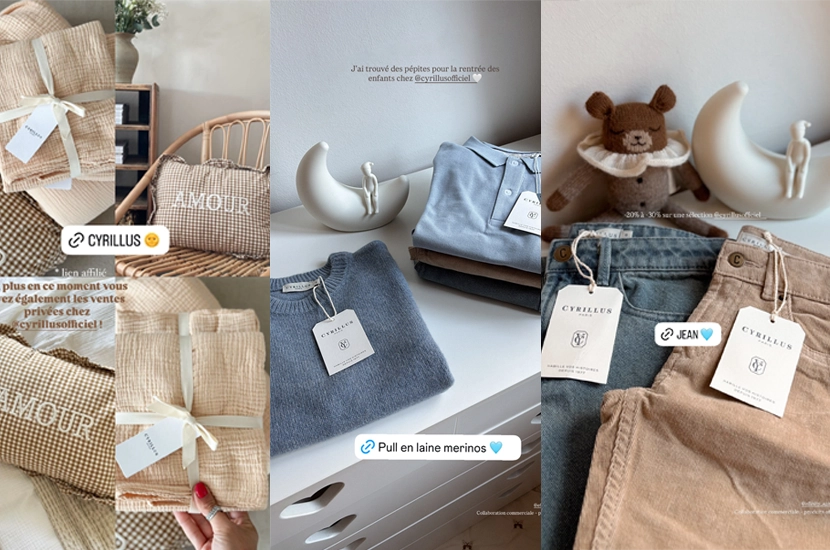
There’s a question that premium brands often ask themselves, with a hint of skepticism: Isperformance-based influencer marketing really right for us?
Fear is justified. Increasing the number of posts, engaging dozens of creators, optimizing click-through rates… all of this seems, at first glance, far removed from a world built on desirability, attention to detail, and image control. Yet Cyrillus did just that. And the results changed everything.
Influence on performance: What exactly are we talking about?
Before getting to the heart of the matter, a clarification is in order. Performance-based influencer marketing is the application of performance-based logic to the world of content creators. Unlike traditional branding-based influencer marketing, where the brand pays for exposure (reach, impressions, fixed compensation), performance-based influencer marketing compensates only for actual actions: a click, a purchase, or a sign-up.
The model works in three steps: the creator produces authentic content that includes a tracked link; the audience takes action by clicking or making a purchase; and the brand pays only if the action is completed. Every euro invested is therefore tied to a concrete, measurable result through specific metrics: conversion rate, CTR, CPA, ROAS, or average order value.
This mature model is driven by what has now become a massive influencer market. In France, there are more than 180,000 active creators, 322,000 pieces of branded content published, and 27.6 billion views generated in a single year (2025 Influence Barometer, UMICC/CPA). In this context, influencer marketing is becoming a full-fledged customer acquisition channel in its own right, rather than merely a tool for brand awareness.
The starting point: a brand with a strong focus on image
Cyrillus is no ordinary brand. Its identity rests on three pillars that its teams champion with conviction: brand image, desirability, and storytelling. Needless to say, the idea of incorporating a strategy perceived as “too commercial” could have sparked very real reservations.
Léna Arnol, Community Manager and Influencer Manager at Cyrillus, puts it plainly: “ Our concern was that this would undermine the brand’s premium positioning. We were afraid of adopting an overly promotional approach or losing control over our image. ”
” The brand wanted to test the impact on performance—but in its own way.
The Turning Point: Realizing That the Market Had Changed
By the end of 2024, several weak signals had become underlying trends. Creators were looking for more sustainable ways to monetize their content. Audiences, for their part, were becoming increasingly receptive to genuine recommendations rather than formulaic collaborations. And above all: the line between brand image and performance was gradually blurring.
In this context, Effinity partnered with Cyrillus based on a simple conviction, championed by Alexia Soulabail, Head of Influencer Marketing at Effinity: “Performance must fit into the brand’s world, not the other way around.”
The strategy: quality first, volume second
Rather than seeking to feature as many designers as possible, the approach was deliberately the opposite: a limited number of profiles, an extremely rigorous selection process, and collaborations designed to last, not just for the moment.
The campaigns were organized around two themes, Fashion and Home, with 10 to 20 designers featured per theme in three-month cycles. The methodology involves retaining the top-performing creators, conducting a detailed analysis of results, and gradually integrating new talent identified through Effinity.
To identify these creators, the Effinity teams relied on Kolsquare, the leading tool in the world of influencer marketing. Thanks to its audience data, performance metrics, and capabilities for analyzing creator profiles, the platform enabled the teams to structure rigorous selections—not based on intuition, but on concrete indicators: engagement rates, audience composition, and thematic alignment with the Cyrillus brand. This saved the Effinity teams a significant amount of time, but more importantly, it ensured relevance: every creator selected met objective criteria even before the first point of contact.
What sets this approach apart from traditional influencer marketing is the central selection criterion: the selected creators hadn’t been recruited in the traditional sense. They were already talking about Cyrillus. Some of them had been long-time customers of the brand.
Léna Arnol sums it up with a phrase that says it all: “ Ultimately, we weren’t the ones who chose the designers—they were the ones who had already chosen Cyrillus. We simply created a virtuous cycle by recognizing their sincere dedication. ”
The Results: A Demonstration Through the Numbers
The qualitative approach did not sacrifice performance; it actually boosted it.
After a few months, the number of clicks recorded surged by 235% compared to the previous year, reflecting a dramatic increase in the program’s overall CTR. The program had 139 actively engaged creators, compared to 33 existing creators. New sign-ups totaled 188, more than four times the initial figure. And 32% of the buyers recruited through this channel were new customers for the brand, illustrating the channel’s ability to drive net acquisition beyond simple customer retention.
These figures definitively disprove the notion that selectivity leads to stagnation.
What the Cyrillus Experience Teaches All Premium Brands About Performance-Based Influencer Marketing
Performance-based influence is not a volume driver disguised as a brand driver. If structured properly, it can be a driver of authenticity in its own right.
Four principles emerge from this experience.
- Choose rather than recruit. Selecting designers is the real strategic move. A designer who already loves the brand doesn’t need to be briefed on what they should feel.
- Start small, but start right. Selectivity is a strength, not a limitation. It’s better to have five perfectly aligned candidates than fifty average ones. This approach protects the company’s reputation while laying the groundwork for sustainable performance.
- Building for the long term. Three-month cycles, with the top candidates being retained, help build a relationship—not just launch a campaign.
- Measure without getting lost in the metrics. The performance is definitely there—the numbers prove it—but it serves the brand’s image, never at its expense.
Cyrillus is concrete proof that performance-based marketing can coexist with a premium strategy—and even reinforce it. It’s not a matter of budget or technology. It’s a matter of approach, editorial consistency, and trust in the creators who have already, of their own accord, chosen the brand.
For brands that are still wondering: the answer lies in the choice of creators, not in their number.